In an interview with the Catholic Bishops’ Conference of England and Wales, Ambassador Chris Trott reflected on the last five years which he has spent as the British Ambassador to the Holy See.
Describing the job as “an opportunity to work with the most extraordinary people you’re ever likely to meet”, Ambassador Trott looked back on the events and accomplishments of the last five years as he prepares to finish his posting at the end of June.
The Ambassador began by explaining that Great Britain and Northern Ireland’s diplomatic engagement with the Holy See focuses primarily, but not solely, on dialogue about global issues, such as conflict and climate change.
“One of the real joys of this job has been engaging not just with the Holy See, but also with all of the large Catholic institutions that are based here in Rome. For example, with the International Union of Superiors General (UISG), with the women religious who have networks in every country in the world virtually, and who do the most extraordinary stuff.
“It’s really humbling, to be able to talk to them about the work that they do and to bear in mind that if we want to talk about global humanitarian crises and development, talking to them about these issues gives an amazing insight. It’s an extraordinary intelligence gathering network.”
The Embassy has built strong relationships and regularly collaborated with these networks over the last five years.
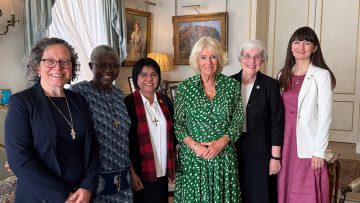
“The ultimate expression of that was when Her Majesty the Queen met six religious sisters during the State Visit, and that meant that the work of the sisters was on the front page of Vatican News. That was really satisfying because for the sisters, I think they felt that we’d given them an opportunity to be seen and to be heard by people in the Apostolic Palace, and as well as to be seen and to be acknowledged by Her Majesty the Queen.”
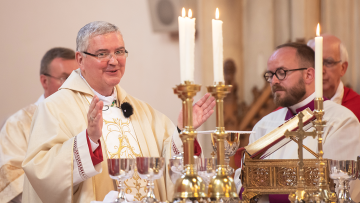
Ambassador Trott mentioned his attendance at the installations of Archbishop Richard Moth and Archbishop Sarah Mullaly as one of many highlights, stating, “I’ve loved being part of all of the complex ecumenical relationships that exist between British people and the Holy See and the Catholic Church.”
Describing the passion that he shared with Pope Francis for the peripheries, the Ambassador acknowledged that “the focus of the Vatican on some of those issues had started under Pope Benedict, but Pope Francis had taken it to another level.”
He recalled his introductory call with Pope Francis: “He wanted to hear my views on the situation in South Sudan, so it felt like this was the ideal job for me.”
Following the most-watched conclave of all time close-up was “an extraordinary privilege”, and the Ambassador reflect that, “the media’s attention was there because yes, the cardinals were choosing a new head of the Catholic Church, but actually what Pope Francis had done through his social media presence, through his engagement on global issues, was to turn the role into a sort of moral voice for the globe, for Christians and non-Christians.”
Another historic moment was the State Visit of the King and Queen to Rome, significant not only for the continuation of the state-to-state relationship, but also for the deeply symbolic moments it contained: “A great message of hope was sent through that striking image of the two together in the Sistine Chapel.”
In a final message to listeners, Ambassador Trott, said:
“My message is a message of thanks, because without the support of the Bishops’ Conference, of CSAN, of all of the different Catholic groups and organisations who have welcomed me, who have sought to brief me, who have received me over the years.
“I leave knowing that the political relationship with the Holy See is very good. The King’s visit showed that while some things may divide us, we are united in our goal, and there is an optimism about this partnership that I think my successor will be able to enhance and take forward.”