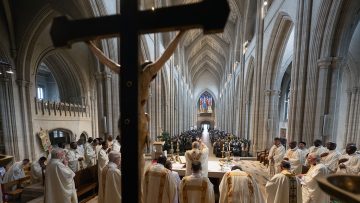
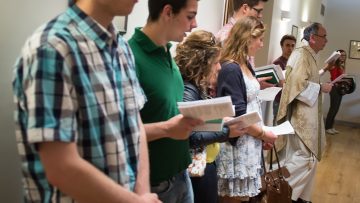
Elliot Vanstone, Senior Mission Adviser, reflects on the importance of Dialogue to help Catholics share their faith and enabling the Church to reach those who may feel distant from it.


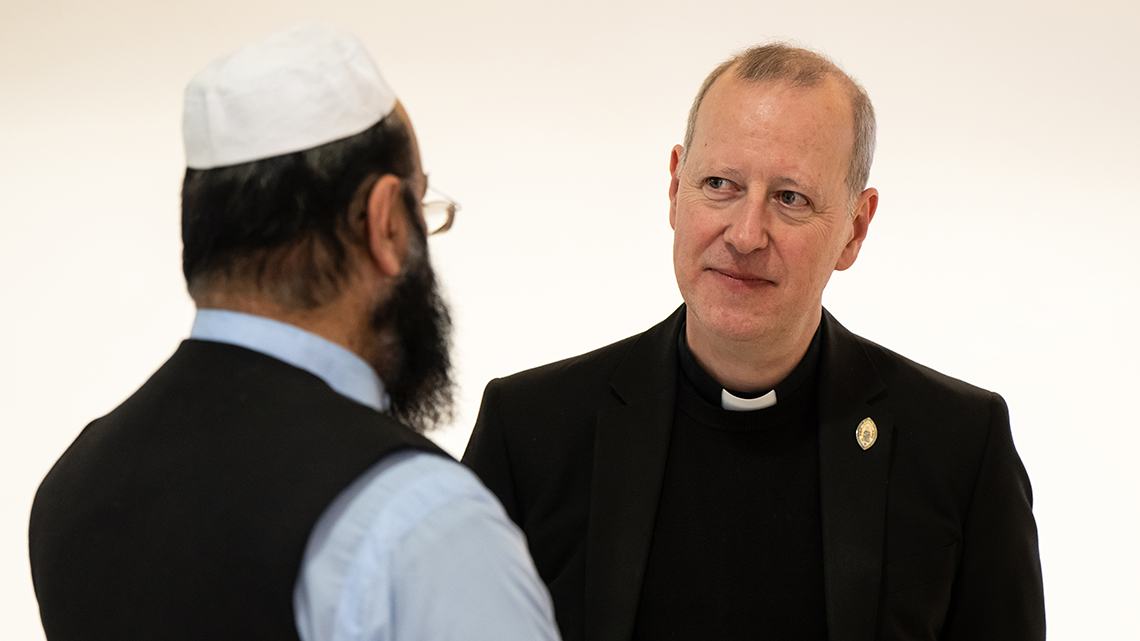
In Magnifica Humanitas, Pope Leo XIV reminds us that the Church is called to walk alongside the people of our time, listening to their hopes and fears and seeking together a more human and fraternal world. He writes: “We wish to engage in dialogue with all men and women of our time, with whom we share in the events, questions and aspirations of humanity.” For Pope Leo, dialogue is not an optional extra to the Church’s mission but instead “openness to dialogue is an integral part of the Church’s vocation.” (Magnifica Humanitas, §2)
This vision has profound significance for the Church’s mission here in England and Wales. Our society is increasingly diverse in culture, belief and religious experience. Interreligious dialogue enables us to meet our neighbours not simply as people who need to hear something from us, but as people whose lives, questions and experiences can also teach us. It creates relationships of trust and friendship in which the dignity of every human person can be recognised, and where Christians can offer the hope of the Gospel with humility and confidence.
The same is true of ecumenical dialogue. The Second Vatican Council taught that “the concern for restoring unity involves the whole Church” (Unitatis Redintegratio, §5). Christian unity is not merely a theological aspiration; it strengthens our common witness to Christ. As Unitatis Redintegratio states, “cooperation among all Christians vividly expresses that bond which already unites them” and provides a powerful witness before the world. (Ut Unum Sint, §40)
This is particularly important for Home Mission. Evangelisation begins with encounter: meeting people where they are, listening to their stories, accompanying them and creating opportunities for them to discover the person of Jesus Christ. Pope Francis expressed this missionary spirit beautifully: “The Church’s closeness to Jesus is part of a common journey; ‘communion and mission are profoundly interconnected’.” (Evangelii Gaudium, §23).
The Mission Directorate exists precisely to support this work throughout England and Wales: helping parishes and dioceses become missionary communities, equipping Catholics to share their faith and enabling the Church to reach those who may feel distant from it.
In Magnifica Humanitas, Pope Leo speaks of the Church as “a home and school of communion”. (Magnifica Humanitas, §86) Our support for Home Mission helps make that vision tangible: building bridges between Christians, fostering friendship with people of other faiths, and opening doors through which people can encounter Christ.
As we support the work of Home Mission, we therefore support more than programmes and initiatives. We support a Church that listens, accompanies and evangelises; a Church that seeks unity, builds friendship and confidently proclaims the Gospel. In the words of Pope Leo XIV, we are called to help build not another Tower of Babel, but “the city in which God and humanity dwell together.” (Magnifica Humanitas, §1)
Elliot Vanstone
Senior Mission Adviser
Mission Directorate
The importance of our Catholic heritage in the age of AI
Abbot Hugh Allan's Home Mission Sunday reflection