Helen Townsend, National Coordinator for Catholic Chaplains in Higher Education, offers a reflection on Catholic Chaplaincy in Higher Education and the guidance it offers the future of the Church.


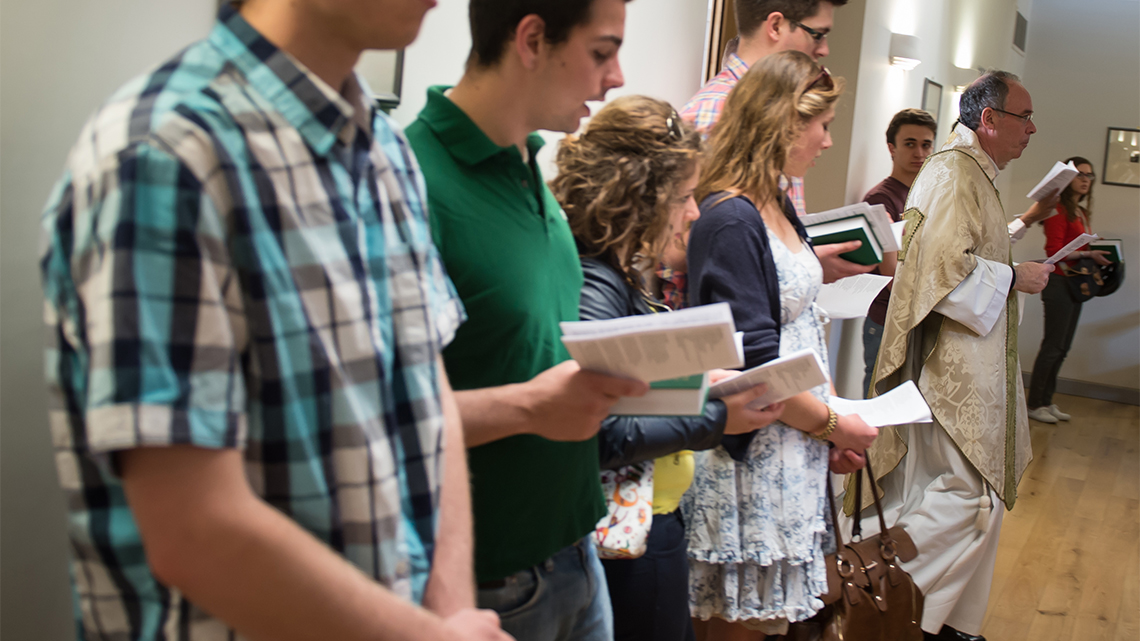
Young people are the future of our Church. When young men and women go to university, they leave behind the care and support of their families, schools and parishes. They begin their lives as independent adults. Young people arrive at university searching for identity, truth and meaning in a fractured and stressful world. The university environment can be a challenging place for a young person. Religious belief and practice may not be valued or respected in the way they would expect or hope.
The Catholic Church provides Chaplains in the university setting to establish a home for those students and staff who are already Catholic, and a place of acceptance and spiritual awakening for those who are searching. Chaplaincy is a ‘home from home’ where students can continue building their Faith, follow on their sacramental journey and find friends to share their love for Jesus and their Catholic values. Mission in Higher Education is led by Chaplains, priests, deacons, religious and lay people, but mission is also very much part of the life of the students and the Catholic staff themselves. Catholic students encourage their lapsed friends to attend Mass and to rediscover their Faith, they invite their non-church-going friends to ‘Come and see’ and they offer a brave witness to their Catholic values, both on campus and in shared accommodation, where questions can range from curious to hostile. They need support to do this.
Chaplaincy provides the space for prayer and sacraments, and for social meetings. They offer talks to inspire and educate students and staff, to form, as St John Henry Newman recommended, people “who know their religion, who enter into it, who know just where they stand, … who know their creed so well that they can give an account of it, who know so much of history that they can defend it.” The Chaplains organise retreats and pilgrimages which can inspire the discerning of vocations to the priesthood and religious life, as well as to the wider vocation to service that is the call of every Catholic. They guide the Catholic Societies and support students in pastoral settings, acting as a signpost to professional services as required.
Higher Education Chaplaincy has a special role to play in welcoming the international staff and students, who have left their countries and sometimes their families to work in a new culture as well as in a new job. “The People of God are not only gathered together from many peoples, but are also intertwined through different functions, vocations, cultures and traditions, each being called to support and enrich one another.” (Magnifica Humanitas ch1 26). Supporting international Catholic staff and students and making them feel ‘at home’ through their Catholic community on campus, is to fulfil God’s command to welcome the stranger. Jesus reminds us that he is the stranger we welcome.
University can be a lonely place. In Chaplaincy, the young men and women who come to the university face an environment that is increasingly automated by AI and by remote forms of learning. In Chaplaincy, they can discover the connection and community that St John Henry Newman desired to promote. Chaplains also work with the Catholic Student Network and the SVP, among other Catholic organisations, to achieve this. The well-being of young people is served best by being connected to a welcoming community, meeting face-to-face, whose values they can identify with and which can satisfy their spiritual thirst. A Catholic undergraduate student from Malaysia was found in tears in the local parish church. When asked what was wrong, she said how happy she was to have come all the way across the world and to feel so at home. It is this sense of belonging that helps students to stay on at university at times of difficulty. For the neurodivergent or disabled student, the acceptance they receive in Chaplaincy can make all the difference. As Pope Leo comments in Magnifica Humanitas, ‘It is individuals that matter, each and every person, together with their families.’
Chaplaincy also provides a safe space in which to encounter other cultures and Faiths, some perhaps completely new to the students, where they can initiate a conversation and learn positive regard in ‘a peaceful and multifaceted culture of encounter’. (MH Ch 2:62) HE Chaplaincy witnesses to the institution as well, ready to question and to challenge institutional cultures or policies that are unethical or lacking humanity. The Mission Directorate supports the work of the one hundred or so HE Chaplains in England and Wales. Each chaplaincy works in a unique setting in terms of the facilities and the model of Chaplaincy. There are residential chaplaincies, multi-Faith-based chaplaincies, and parish-based chaplaincies. Some of the Chaplains serve more than one institution and divide their time between the Chaplaincy and other commitments. The Mission Directorate offers HE Chaplains personal support, resources, training and regional meetings as well as supporting the Annual Conference.
Through its support of HE Chaplaincy, the Mission Directorate serves the Catholic men and women who study and work at universities and seeks to strengthen and enrich those are who are witnesses to Jesus now, and who are the Church of the future.
Bishop Philip Egan emphasised that many more people should come to know ‘the God who made them’.
The importance of our Catholic heritage in the age of AI