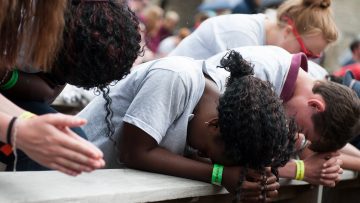
Fleur Dorrell, Biblical Apostolate Manager and Faith and Formation Manager, reflects on technology and it's ethical challenges to human dignity.



And the Lord said, “Behold, they are one people, and they have all one language, and this is only the beginning of what they will do. And nothing that they propose to do will now be impossible for them.” Genesis 11:6.
Magnifica Humanitas addresses human life in our present paradigm shift into an era of artificial intelligence and AI-led technology, and leans on key biblical narratives to frame the ethical challenges to human dignity. With its focus on safeguarding the human person and guiding technical progress through human dignity, it raises various questions for us as believers. Magnifica Humanitas sees the mission of the Church as a call to reject techno-cratic isolation and instead build a culture of communion, solidarity, and the common good.
In this reflection we explore how Pope Leo’s use of Scripture helps us to understand this mission. The primary Biblical foundation of the Encyclical is a creative engagement with the story of the Tower of Babel in Genesis 11:1–9 and the post-exilic re-building of Jerusalem in Nehemiah 2–6 and ends with the Magnificat in Luke 1:46-55 as a radical reminder of new kingdom values.
The Tower of Babel (Genesis 11:1–9)
This story is framed as a warning against self-assertion, human hubris in our new era of algorithmic control. It depicts humanity attempting to reach heaven without God, resulting in fragmentation and confusion rather than true unity. It is located at the end of the Primeval or Biblical pre-history period (Genesis 1-11) and is the last recorded event before salvation history begins with the call of Abraham.
In the Creation Account in Genesis 1 the underlying relationship between the Creator and the creatures is of speaking and hearing. The use of clear and coherent language is decisive for the way creation is to be. So, St Paul’s exegesis is incisive when he writes “God calls the worlds into being” (Romans 4:17). This gives even more force to the final story of pre-Israelite humanity (Genesis 11:7) where the narrator simply states lo’-shema’, they did not listen. When humanity does not listen, it cannot respond as God’s true Creation. So God’s call goes unheeded, but God will continue to call, not by coercion but as invitation, and in hope. While repeatedly resisted and ignored, the Creator’s call remains, to find its full response in the new Adam, Christ.
Initially, the progression of stories in Genesis seems dire with the disobedient response of the first humans, Adam and Eve, (3:1-7); the murderous act of Cain (4:1-6); the condemnation of the world in the Flood (6:5-13); and finally, the fragmentation of the nations in Babel (11:1-9). Yet even amid this fallout there are hints of an alternative reality. The Creator rests because the creation is “good” (2:1-4); the cycle of life remains guaranteed (8:21-22); the creator embraces and renews the creation in a new covenant (9:8-17); Noah will be the model of the creaturely obedience that Adam rejected (5:29); and all of this is summarised in the teaching on the image of God within us. There remain a promise and a hope. God remains sovereign Creator and the creation may yet become whole.
The issues of individual sins before the Flood now takes on a collective dimension. We see just how wrong human decisions can be and how they remain unresolved in the story of the Tower of Babel. The context is the Mesopotamian empire of Babylon which assumed both it, and its god Marduk were superior to all others. This is symbolised in its great Temple, the Ziggurat of Entemenanki, seeming to join heaven to earth. Babel is clearly a pun both on the empire’s conceit but also with the Hebrew verb balal, meaning ‘to confuse’. The growth of many nations after the Flood was seen as a blessing but a unified humanity has now led to a collective sense of omnipotence and divine status – hence the divine response of “Come, let us go down to confuse “… (Genesis 11:7). But there still remains a promise – at the heart of which is the message that God is patient and will not abandon his creatures (cf. Romans 3:25-26). God waits patiently for their true, considered, response.
Questions for Reflection
Averting a new “Tower of Babel”.
“let us make a name for ourselves, lest we be dispersed over the face of the whole earth.”
Genesis 11:4b
Self-sufficient technological power that excludes God and negates human difference is contrasted with the collaborative mission and building of a holy community.
How can we listen to God more deeply?
How can we listen to each other more patiently?
Where can we find the truth today?
Pope Leo uses as a positive counter-model to Babel, Nehemiah’s rebuilding and fortification of the walls of the destroyed city of Jerusalem. It is a work based not on self-seeking pride, but on a slowly developed shared responsibility for the common good, built on prayer, dialogue, and care for the vulnerable.
Ezra and Nehemiah face extraordinary difficulties in returning to Jerusalem to help its reconstruction, the renewal of worship in the Temple and the re-statement of the Mosaic Covenant and Law in what will become the Pentateuch. So much had disappeared, the Temple and priesthood, the monarchy and government. The great Solomonic city had been reduced to a ruin – no more than a rural township. Even the re-built Temple seemed insignificant compared with the splendour of Solomon’s great enterprise. Yet their mission was clear and divinely purposed – “the king granted me what I asked, for the good hand of my God was upon me.” Nehemiah 2:8.
The wider socio-political context was that while Persia was the dominant superpower, Egypt had begun to challenge its dominance in a series of revolts. It suited the Persian Emperors, Cyrus and Artaxerxes, to build buffer zones between Persia and its hinterland. Jerusalem and Judah met these needs as well as providing a new source of tribute in terms of material goods, precious metals and, when needed, human labour. So, Ezra who could trace his ancestry through the pre-exilic line of high priests and Nehemiah who had risen to be the Emperor’s cup bearer, a figure of significant authority in the Persian court and well-used to the exercise of management and diplomacy, were carefully chosen to work within this complex and fragmented world.
Ezra would re-establish the cult of the Temple and draw together the Law so that it could be formally received by the people of God. This now included, those left behind at the time of the Babylonian Exile. Some of these people had risen to power, a large number had inter-married with other non-Hebrew regional peoples, and thousands of returnees had been formed in their faith and practice as aliens in a foreign land which had enriched their sense of uniqueness and identity. Meanwhile, among those who had prospered over the years in the Land, there was opposition to this restoration which would inevitably undermine their status and their widespread practice of debt slavery and abuse of the poor (5:6-13).
I was very angry when I heard their outcry and these words. I took counsel with myself, and I brought charges against the nobles and the officials. I said to them, “You are exacting interest, each from his brother.” And I held a great assembly against them and said to them, “… you even sell your brothers that they may be sold to us!” Nehemiah 5:6-8.
Some protested to the Emperor while others planned military action or created disturbances to slow down any such re-organisation. Nehemiah, after being appointed to this daunting task by Artaxerxes and before setting out on the Journey to Jerusalem, goes aside to fast, pray for the people and for discernment. He starts by listening for the voice of God. He encourages Levites, descendants of the Temple servants, to return with him.
On arriving Nehemiah selects a few assistants and walks the city boundaries by night to get an accurate sense of the task before them. Then he gathers the leaders of those still within the city and those from the ancient families who live in its hinterland and puts forward his vision of restoration. Nehemiah invites them, family by family, to participate in the reconstruction of the walls and gates. He appeals to their sense of identity and their common covenant with God. Despite opposition from nearby leaders, he builds a consensus and together he, his returnees and the gathered people, rebuild the city walls within fifty-two days amid attempts of local elites to threaten and undermine their efforts. In the process his own selfless lifestyle and generous open table fellowship set a new standard for the leaders and Temple officials. As a result of the goodwill he creates, he can demand significant changes in the return of alienated lands and the reduction of debt slavery. Homes are re-built within the city, and it becomes re-populated.
Pope Leo uses Nehemiah’s campaign of restoration to highlight what is necessary for the evolution of any true human development and mission. In-depth listening to all involved and those most affected, clear sharing of the fundamental vision, invitation for all, young and old, men and women – to participate with shared responsibility in the process and its outcomes. All held in prayer – placing the creator God at the centre of the project and mission. The aim is for a common language, not of uniformity, but of unity and communion. But the story of Nehemiah is more complex. His restoration will involve the exclusion of non-Hebrew spouses. The new borders will include exclusion.
Questions for Reflection
What are we building and for whom?
“No such things as you say have been done, for you are inventing them out of your own mind.” For they all wanted to frighten us, thinking, “Their hands will drop from the work, and it will not be done.” But now, O God, strengthen my hands. Nehemiah 6:8.
The centralised control necessary, has within it the very dangers seen in the same potential control of a single system like the internet and AI. This sits uneasily with the vision of collective human flourishing Pope Leo wishes to promote.
What is the mission of the Church in a world of artificial intelligence?
What are the dangers and threats?
How do we build this mission and with what kind of resources?
In the conclusion of his Encyclical, Pope Leo turns to Mary’s Song at the beginning of Luke’s Gospel. He puns on its title and that of the Magnifica/Magnificat. The title deliberately evokes the Canticle of Mary, calling Christians to be icons of humble faith and hope during times of profound historical change.
Luke’s Gospel begins with a song from the prophetic imagination of Mary when she meets Elizabeth whose child John dances in her womb, like David before the Ark of the Covenant coming to Jerusalem. The two women pour forth the purest prophetic imagination of their people. The controlling, patriarchal voice, in this case of Elizabeth’s Priest-husband Zachariah, is silent. Until he bends to the free will of the free God, the only voices heard in this household are two women who with extraordinary intensity anticipate a new Kingdom.
God will come close again in sovereign freedom starting not in the Temple or the Law court or the holy places, nor among the elite who control our world but from the little ones, the poor, the oppressed, the vulnerable. For “he has filled the hungry with good things, and the rich he has sent away empty.” Luke 1:53.
Mary’s Song points towards a new common good in an unforeseen and freed community which is also our mission to realise and celebrate once again. A community both online and in person that is still evolving in ways that we cannot predict, but in which we can anticipate in hope, and all participate in creating.
This, Pope Leo suggests, is what the Book of Revelation, at the end of the New Testament, is referring to in the image of the New Jerusalem that comes down from heaven into our midst (Revelation 21:2). Its waters slake the deepest thirsts of the human heart, and the leaves of its trees provide healing for our wounds. In the light of God’s renewed indwelling among Creation, we eventually attain the dignity promised us from the beginning of Creation as sons and daughters of the Father, created in the image and likeness of God. The dignity we are all called to – whether poor or powerful.
That AI and other technologies may be a partial means to such transformation is indeed possible. But the challenge remains in how these can, with discernment, be used for the common good. Technology is not neutral – digital tools and algorithms mirror the moral character, biases and power dynamics of those who create, finance and market them.
Left unregulated, they become a means of empowering an elite to greater wealth with an even greater sense of power at the expense of the planet, the poor, the frail and vulnerable.
So Pope Leo presents the challenge and provides some guidelines for moving towards a resolution with some of the spiritual resources available to us. But this is only a beginning.
When Jesus taught, he taught in open-ended parables. He drew on the experience of the people, provoking them to see their world clearly but from a renewed perspective – “the kingdom of God”. He invited them to become subjects of their own history. He empowered the exploited to re-claim their history, to see it anew, and to participate in creating it.
At times we have read these texts and spiritualised them into a personal message – what do they mean for me? In so doing, we miss their essential provocative nature and their call to renew our collective vision and mission of a creation under God. There, all are of equal worth. The distribution of the earth’s goods and solidarity in service, are at the centre of our collective mission rather than the accumulation of profit, personal security and power.
Questions for Reflection
Putting the vulnerable at the centre – not the margins.
“… he has scattered the proud in the thoughts of their hearts;
he has brought down the mighty from their thrones
and exalted those of humble estate…” Luke 1:51-52.
The dignity promised us from the beginning of Creation, as the children of God created in the image and likeness of God is the dignity we are all called to – whether poor or powerful.
Does our digital life uphold human dignity or treat workers like disposable parts?
Are we protecting our choices against digital manipulation and technological dependencies?
Who has the power to harm and heal in our digital mission?
Defending human dignity in the digital age
The Church’s primary mission is to remind society that human beings are created in the image of God and are not mere units of data efficiency, statistics or projects to be optimised.
Fostering real communities
Rather than retreating into fear or hostility, our mission is to engage openly with technology while promoting creative dialogue, social justice and a “civilisation of love”.
Truth finding and telling
Can we still recognise reliable sources and reality over automated disinformation, hyper and virtual realities? Our mission is to share God’s truth.
Being a voice for the vulnerable
Our mission requires listening to victims of algorithmic injustice, eco-political displacement and modern warfare, acting as a “construction site of hope”.
Above all these Biblical texts provoke collective reflection, renewed imagination and debate, starting from the conflicted reality we find ourselves in. Pope Leo’s teaching challenges us to return to the Scriptures, to Church Tradition, to our Faith as we grapple with our mission in a world of ever-changing, virtual and artificial realities.
Fleur Dorrell
Biblical Apostolate Manager
The importance of our Catholic heritage in the age of AI
Abbot Hugh Allan's Home Mission Sunday reflection
Bishop Philip Egan emphasised that many more people should come to know ‘the God who made them’.