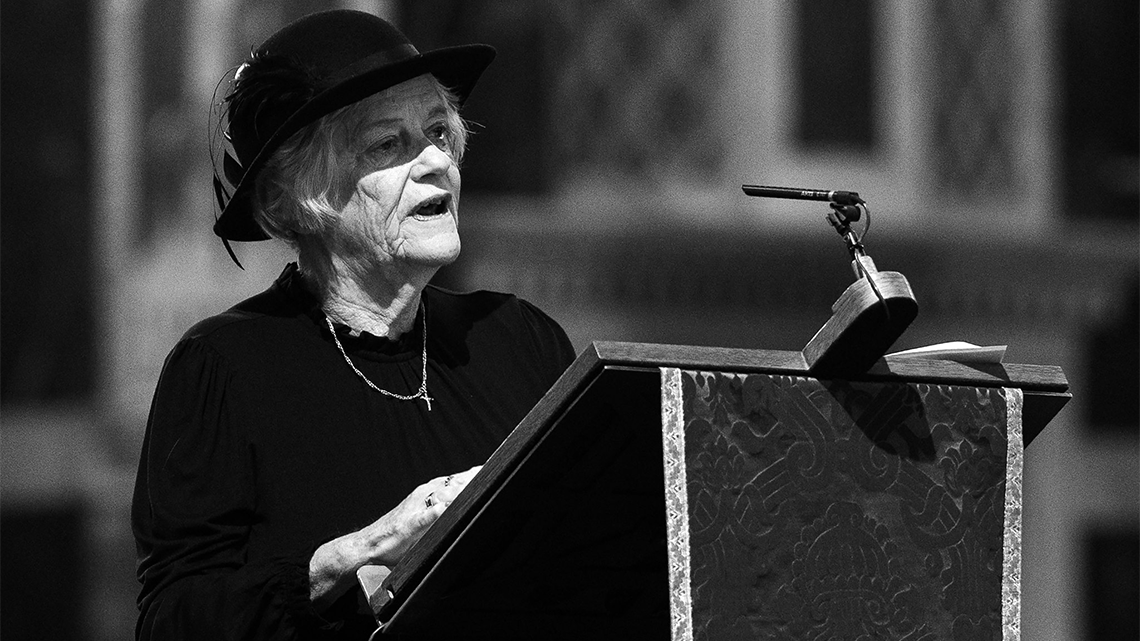


You can browse or download high-resolution photographs from our Flickr Photostream. More images from this album can be found here.
Tribute given by Lord Alton and Right to life
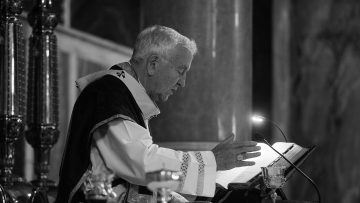
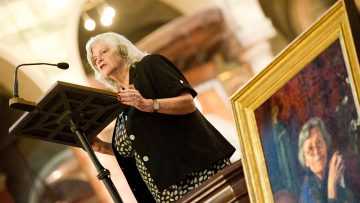
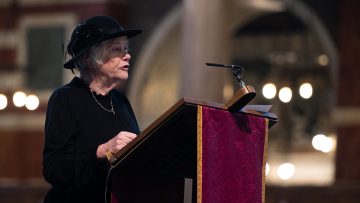
Pro-life veteran and former Minister and MP, Ann Widdecombe, received a memorial service at Westminster Cathedral, London, today, 26 November, following her tragic death in July this year.
During her long and distinguished career in Parliament, she was a leader in the public fight for protections for unborn children at the beginning of life and the elderly and vulnerable towards the end of life.
As a patron of Right To Life UK for many years, her strong and consistent pro-life voting record serves as an example and aspiration for younger pro-life politicians entering the world of being a publicly pro-life politician. The Right To Life UK senior team attended the memorial service and brought a wreath on behalf of their patrons, trustees, staff, and supporters. Its message read, “With heartfelt gratitude for protecting and defending the right to life of human beings at all stages.”
The Prime Minister, as well as three former Prime Ministers, joined MPs, Peers and other public figures at the service to remember Ann and give thanks for her life.
In his tribute at Westminster Cathedral earlier today, Lord David Alton of Liverpool recalled Widdecombe’s love of Mother Teresa of Calcutta’s prayer on the value of life. “Ann totally dedicated herself to that fight for life,” he said. He praised her “courage and tenacity”, saying she threw “every last morsel of energy into the causes she embraced”.
Ann Widdecombe was 78 when she was killed at her home in Haytor, on Dartmoor. She was found there on 9 July 2026, after an employee who had been unable to reach her went to the house. On 20 July, a man was charged with her murder.
On 12 August, family, friends and former colleagues gathered for her funeral at Buckfast Abbey, where she had regularly worshipped. She had called the abbey her “safe haven”. Those who knew her there remembered her warmth and the depth of the Catholic faith that shaped her public life.
First elected as a Conservative MP for Maidstone in 1987, she held her seat until leaving the Commons in 2010, during which time she held two posts as Minister of State, including at the Home Office with responsibility for prisons and immigration. She was the only Prison Minister to have personally visited every prison in England and Wales.
She returned to frontline politics in 2019 as a Member of the European Parliament until January 2020.
During her time in politics and after, she consistently voted in favour of greater protections for unborn children and against attempts to legalise assisted suicide. As early as 1988, as a newly elected MP, Widdecombe served on the committee scrutinising David Alton’s Abortion (Amendment) Bill. Alton recalled that the two travelled around the UK, speaking at public meetings about why MPs from different parties had joined forces to protect unborn children.
In 1989, Widdecombe moved the Second Reading of the Abortion (Amendment) Bill to give MPs another opportunity to vote on restrictions on late abortions. In a separate Commons debate, she pressed the case for compensation for women who had agreed to an abortion after being wrongly told that their unborn child had a severe disability.
Additionally, in the same year, Widdecombe questioned the Solicitor General and later secured a Commons debate about a baby reported to have shown signs of life after an abortion in Carlisle. She pressed ministers on what legal protection such a child had and what recourse the parents could seek.
In his speech earlier today, Lord Alton made referenced this incident saying Ann had been “deeply shocked by the Carlisle baby case”. He recalled her question to the Commons: “How can one accept, when a child has been breathing without the aid of artificial equipment, has a pulse rate and has survived for three hours, that that was not a live birth? Under what circumstances do we call a person an unperson?”
The following year, in a debate on the Abortion Act 1967, she argued that abortion should not be treated as any other medical intervention and that existing protections for unborn babies should not be eroded further.
In the same year, when debating amendments to the then Human Fertilisation and Embryology Bill, Widdecombe insisted that unborn children not be left out of the discussion, arguing that, due to medical advances, the abortion limit should be lowered.
In another debate in the same year, Widdecombe raised concerns that an amendment to abortion legislation, allowing the Health Secretary to designate “a class of places” as suitable for abortions, would inadvertently pave the way for at-home abortions.
However, the author of the amendment, Robert Key MP, dismissed Widdecombe’s concerns and accused the then Conservative MP of speaking from “the whip issued by the pro-life group” and misleading Parliament.
The Health Secretary at the time, Kenneth Clarke, then assured MPs that the legislation was not intended to legalise home abortions and that the abortion pill would only be “administered only in closely regulated circumstances under the supervision of a registered medical practitioner”.
30 years later, Ann Widdecombe’s then-dismissed concerns have become a reality in the form of pills-by-post abortion, which, as of 2023, accounts for 72% of all abortions in England and Wales.
In 2003, Widdecombe tabled a motion defending Muslim applicants to medical school who objected to abortion or the legalisation of euthanasia. She asked the Government and the General Medical Council to ensure that admissions procedures respected applicants’ conscientious beliefs.
In 2007, she supported a Bill that would have required parents to be informed if their child under 16 had an abortion.
In 2008, she voted in favour of a series of amendments to the Human Fertilisation and Embryology Bill, including an amendment to lower the abortion limit for abortions performed under Section 1(1)(a) of the Abortion Act to 12 weeks. She took the campaign for a lower abortion time limit to a public meeting in London as part of her ‘Passion for Life’ speaking tour.
The following year, Widdecombe tabled a Commons motion calling for the withdrawal of the Director of Public Prosecutions’ guidelines on assisted suicide. She argued that the guidance put vulnerable people at risk and that any change in the law was for Parliament to decide.
While appearing on Strictly Come Dancing, she was guest of honour at Right To Life UK’s first fundraising dinner in London. The event drew 120 supporters, and the campaign group Abortion Rights called a demonstration against her appearance.
Her campaigning appears to have carried a political cost. The Guardian’s obituary attributed the slow start to her ministerial career partly to her outspoken support for Alton’s abortion campaign. She received her first ministerial appointment in 1990.
Thirty years after questioning ministers about abortion pills being taken at home, she signed a High Court witness statement in 2020 supporting Christian Concern’s challenge to the Government’s authorisation of at-home abortions. She set out the assurances MPs had received in 1990 and explained why she believed the change required a parliamentary vote.
Widdecombe continued to keep abreast of recent expansions in abortion law. In 2023, writing in The Critic, she opposed the proposed buffer zones around abortion clinics. She described the experience of a woman who wanted to keep her baby and had been offered accommodation, food vouchers and baby clothes after meeting a volunteer outside a clinic.
Widdecombe also served in a senior role in the All-Party Parliamentary Pro-Life Group and fought against attempts to make assisted suicide legal in 1997, 2000 and 2004.
Widdecombe backed practical alternatives to assisted suicide to reduce suffering at the end of life. In April 2006 she signed a Commons amendment opposing Lord Joffe’s Bill that also called for expanded hospice provision and research into progressive supranuclear palsy, the condition of a woman whose assisted death had featured in the debate.
She did not just talk the talk though. Earlier today, Lord Alton recalled how Ann brought her mother, Rita, to live with her in London in her final years. He said that just as her mother “had cared and prayed for her when she came into the world, she would care and pray for her beloved mother as she left this world for the next”.
Even after leaving the Commons, she continued her vocal opposition to assisted suicide. In 2006 she strongly opposed the notion, advanced by Dignitas founder Ludwig Minelli, that clinically depressed people should be assisted in suicide. “It is absolutely ludicrous. The answer to clinical depression is to get people help not to end their lives”.
“I think this is one very dangerous man and one very dangerous organisation”.
In 2012, Care Not Killing named her as a speaker for its Westminster rally calling for better palliative care and opposing assisted suicide and euthanasia.
In the debate over Kim Leadbeater’s then Lauren Edwards’, assisted suicide Bill, Ann Widdecombe was a powerful and consistent voice in the media opposition to this legislation because of the negative effects it may have on the vulnerable.
In the months before Leadbeater launched her Bill, Widdecombe warned that, if assisted suicide were made legal, “it is impossible to introduce adequate safeguards to protect the mentally ill, disabled and the frail elderly”.
She later described the assisted suicide Bill as “riddled with horrors”, saying that “Appeals [in cases of assisted suicide under the Leadbeater Bill] work only one way: one can appeal against a refusal but a relative, concerned about suspected coercion, for example, cannot appeal against an affirmative decision and coroners cannot investigate”.
Chris Whitehouse, a Right To Life UK Trustee, said “For 40 years, Ann was to me a personal and family friend, a political mentor and a remarkable heroine of the pro-life cause. To have known her was a pleasure and a privilege, if sometimes a challenge. She was unflinching in her politics, constant in her friendships and steadfast in her defence of the principle of the right to life, both for the unborn and for those approaching the end of their lives”.
“May the choirs of angels come to greet her, may they speed her to paradise, may the Lord enfold her in His mercy, and may she find eternal life and rest after a lifetime of pro-life endeavour”.
Friend and former colleague of Ann Widdecombe, Lord Alton, said “Ann’s forthright views – whether you agreed with her or not – were always trenchantly, intelligently, and honestly expressed – and never with malice”.
“Beyond the well-known public figure, there was also a less well-known private person, capable of great kindness in responding to people facing personal challenges and tragedy. As they will attest, she was never a fair-weather friend”.
“At a time when the national debate needs respectful disagreement and intelligent debate, Ann’s voice will be missed”.
“I will not be alone in mourning her passing”.
Source: Righttolife.org.uk