Source: Elena Curti, The Tablet
The church in Wallsend heads a list of nine Catholic churches to receive grants announced today by the Department for Digital, Culture, Media and Sport.
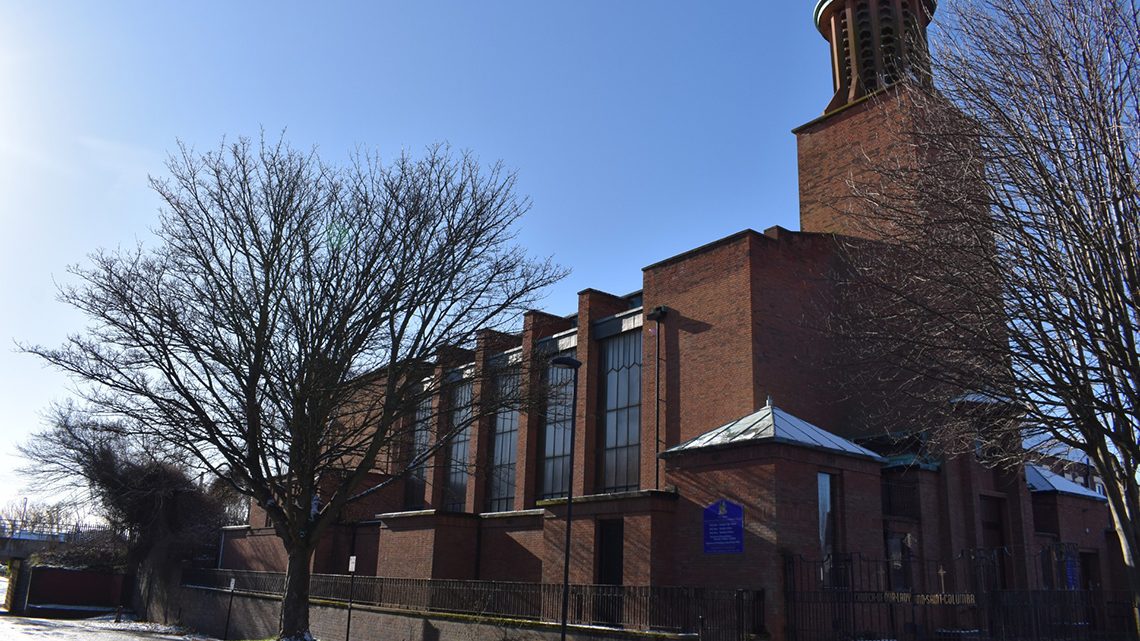
Our Lady and St Columba, in the Diocese of Hexham and Newcastle, will receive £1 million for a new roof. The architect Vincente G. Stienlet (1910-90) was the second member of an architectural dynasty spanning three generations. The practice, Pascal Stienlet and Son, was based in Newcastle and renowned for designing cinemas, theatres and places of worship all over Northern England.
The architectural and historical review of Catholic churches in England and Wales, Taking Stock says Our Lady’s is “a bold and impressive design of the 1950s, blending Modern Perpendicular Gothic, Scandinavian and Art Deco elements”. The church was built by a highly skilled local workforce who faced the building inside and out in high-quality bricks just two inches thick. The church’s louvred bell tower with its copper roof is a much-loved local landmark. It was listed Grade II in 2016 following the Taking Stock review.
Also to benefit from the grants are two churches in the Archdiocese of Liverpool, St Matthew, Clubmoor (1930), which receives £810,000 and St Anthony of Egypt, Scotland Road which has been awarded £775,228.
St Matthew’s was the first church by F.X. Velarde who studied at Liverpool School of Architecture and went on to design some of the most distinctive and original Catholic places of worship of the twentieth century.
St Anthony of Egypt (1833) is a large, early Gothic Revival building on the main road north of Liverpool. It is one of several city churches that served poor Irish families who arrived in large numbers from the 1840s in the wake of the great famine. The church has an enormous brick-vaulted crypt which runs the length of the church and contains around 700 burials.
The grants are the first to be awarded from the new Places of Worship Renewal Fund, designed to support historic places of worship, range from nationally renowned minsters to churches and synagogues in areas of the greatest need. A total of 51 recipients will share over £18 million.
Sophie Andreae, vice chair of the Patrimony Committee of the Catholic Bishops’ Conference of England and Wales, said:
“We are delighted that nine Catholic churches in England are to receive funding from the government’s new Places of Worship Renewal Fund administered by Historic England. All these churches, ranging in date from the Victorian period right up until the 1960s, are key local landmarks. Their congregations play an important part in their respective communities so ensuring church fabric is not failing and becoming a burden will give a great boost all those involved. We are so pleased the government has introduced this new grant scheme to support listed churches with urgent capital repairs.”
The full list of Catholic churches to receive grants from the fund are:
Our Lady and St Columba, Wallsend, Newcastle
(Grade II) £1million
A bold and impressive design, the church was constructed in 1957 blending Modern Perpendicular Gothic, Scandinavian and Art Deco elements. The architect was Vincente Stienlet. The church has great presence in the townscape.
The grant will support the replacement of the failing copper roof with insulated zinc, renewal of flat roofs and rainwater goods and improvements to the drainage strategy. The project also includes repairs to brick piers and associated fabric.
St Matthew’s, Clubmoor, Liverpool
(Grade II) £810,000
This was Francis Xavier Velarde’s first church and was completed in 1930. The tower has considerable landmark value and the interior is remarkably unaltered.
The grant will be used for urgent repairs to the aisle and bell tower roofs, improvements to rainwater disposal, repointing and repairs to external masonry and windows. The project also includes improvements to boundary walls and paths and installation of accessible toilets.
St Anthony of Egypt, Scotland Road, Liverpool
(Grade II) £775,228
This fine Gothic Revival church was designed in 1833 by John Broardbent, a pupil of Thomas Rickman. It is a significant landmark and has a fine interior. Dedications to St Anthony of Egypt are very rare.
The grant will allow for full stripping and reroofing of the nave and narthex, repairs to gutters and lead flashings, external masonry and leaded windows and renewal of cast-iron downpipes. Further works will address timber decay, wall and internal plaster repairs and redecoration.
Cathedral of St Alphonsa, Preston
Syro-Malabar Eparchy of Great Britain
(Grade II*) £307,200
Built for the Jesuits in 1833 to designs by J.J. Scoles, the church was originally dedicated to St Ignatius. It was extended by Joseph Hansom in 1858. It has connections with two famous poets: Francis Thompson was Baptised there in 1859 and Gerard Manley Hopkins was a curate there in the 1880s. Following a period of closure, the church was taken over by the Syro Malabar Eparchy of Great Britain in 2025 and now serves as their Cathedral.
The grant will support a comprehensive programme of repairs, including replacement of lead flashings and gutters, repair of dry-rotted timbers, roof and slate repairs, insulation, lantern and cornice repairs, lime replastering and repointing.
St Joseph’s, Leigh, Greater Manchester
(Grade II) £188,000
Designed by Joseph Hansom and built in 1855, this church has a strong architectural presence, and its west tower is a notable local landmark. It was built for the Jesuits who are recorded as having a mission operating in Leigh as far back as 1670. The interior is typical of the wide and open church plans favoured by the Jesuits and based on the principles of Catholic church design that emerged from the Counter Reformation with visual emphasis focussed on the sanctuary.
The grant will enable conservation and repair of the west tower, including masonry and buttress repairs, replacement of severely weathered stonework, repointing, removal of vegetation and investigation of the bell chamber. The project also includes repairs to churchyard fencing and entrance features to improve accessibility and security.
Sacred Heart, Blackpool
(Grade II*) £145,868
This church was the earliest and most architecturally ambitious Catholic church in Blackpool. It was designed by Edward Welby Pugin in 1854 and paid for by Miss Monica Tempest of Broughton Hall, near Skipton. The original church quickly became too small for its growing congregation and in 1890 it was extended under the direction of Peter Paul Pugin, younger brother of Edward, who was responsible for the most striking and original feature of the church, the large octagon.
Grant aided work will include repairs to the north transept window and gable, including stone window repairs, leaded glazing, repointing, leadwork to the lower roof and internal plaster repairs. The project will address urgent deterioration and protect the historic fabric of the church.
St Patrick’s, Winson Green, Birmingham
(Grade II) £138,526
A large red brick Gothic church of 1895 of high townscape value, the church is notable for the quality and richness of its internal fitting out. It was built to the designs of the architectural firm Dempster and Heaton of Birmingham.
A programme of repairs to external stone detailing and brickwork, including localised repairs, repointing and replacement of severely deteriorated masonry. The project also includes repairs or replacement of doors and windows, internal decorative repairs, drainage repairs and boiler replacement.
Our Lady, Lillington, Warwickshire
(Grade II) £119,066
A powerful and expressive centrally planned, concrete framed building by local architect, Henry Fedeski in 1963, the design was strongly influenced by Gerard Goalen’s church of Our Lady of Fatima, Harlow, completed a few years earlier. Like Harlow, the church at Lillington incorporates an extensive scheme of brightly coloured dalle de verre glass designed by Dom Charles Norris of Buckfast Abbey.
This grant will allow for urgent roof and rainwater repairs to be carried out, and address longstanding water ingress, including replacement of soffits and fascias, roof repairs, rainwater goods, asbestos removal and improvements to drainage. Interior repairs will also address water-damaged finishes and parquet flooring, helping secure the church’s continued use as a place of worship and community outreach.
St Peter’s, Gorleston, Norfolk
(Grade II*) £43,252
St Peter’s, Gorleston, Norfolk, is the only church designed by the sculptor, letter cutter, typeface designer and printmaker, Eric Gill. Built in 1939, a year before Gill’s death, it is a remarkably early example of a Catholic church designed with a central altar, foreshadowing the layout that was to become popular following the Second Vatican Council. The funding will support the repair of existing timber windows that are in poor condition and vulnerable to water ingress, alongside redesign of the tower parapets and roofing works to address leaks. The project will help protect the building’s historic fabric and ensure its continued use as a place of worship and community outreach.
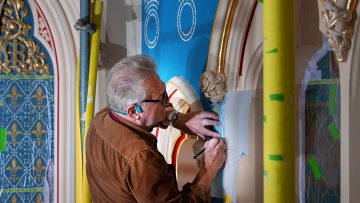
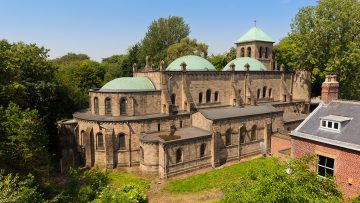
Featured images are of Our Lady and St Columba, Wallsend. © Andy Bull