On 18 November, Catholic charity Aid to the Church in Need (ACN) marked the 10th anniversary of Red Wednesday, its annual campaign raising awareness of religious persecution and supporting Christians facing discrimination, oppression and violence because of their faith.
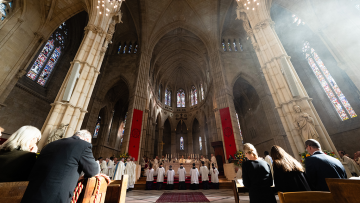
The main event in London took place at St George’s Cathedral, Southwark, featuring red illuminations, light displays and live music, culminating in a Mass celebrated for persecuted Christians.
The Mass was led by Fr Firas Lutfi OFM, whose ministry in Syria has accompanied communities through years of conflict, loss and rebuilding.
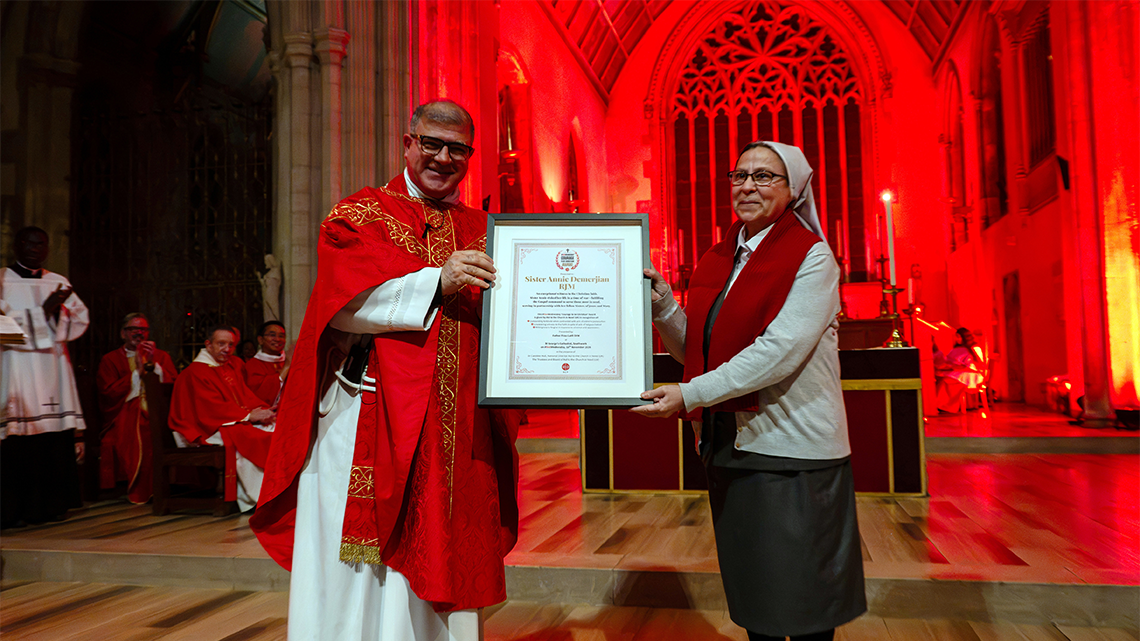
A highlight of the evening was the presentation of ACN’s Courage to be Christian Award to Sister Annie Demerjian, the Syrian religious sister who ministered in Aleppo during the country’s brutal civil war, supporting families affected by violence, displacement and poverty.
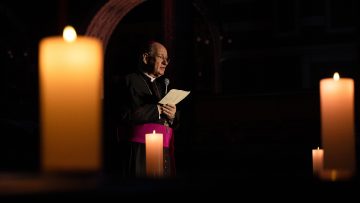
Ahead of the Mass, Fr Firas and Sr Annie gave an interview to the Bishops’ Conference of England and Wales, sharing their first-hand testimonies of the realities facing the people they serve and the resilience of Christian communities living amid conflict.
Sr Annie shared that the announcement of the award had come as a surprise and she dedicated it to “every consecrated person who remained during the war in Syria.”
She explained how her community, alongside the many lay people who helped them, grew along with the increasing dangers and needs which the war brought the people of Syria.
“Looking at the suffering of the people around us, we couldn’t stand doing nothing. … The needs were great, in the sense of the suffering. There was a lack of electricity, sometimes of water, a lack of the important things, the dignity of the people. It’s very painful to see an old man who is crying or a woman who cannot feed her children.
Sr Annie and her community worked in schools and communities, visiting people in their homes and eventually opening their convent to all as a safe place for local people.
“For me, it’s a sacred place we enter, and it’s amazing when they share with us very, very specific things which usually you don’t need to share. For me, this shows lots of trust from their part to us.”
Supporting the people during the war was a combined effort with other organisations and religious communities who all shared the same question: “How can we eliminate the suffering of our people?”
Sr Annie explains: “How? It’s not easy. When you see a family lose everything, in front of this experience, you find no words. Sometimes presence, sometimes silence. When you feel that one year, the eve of Easter, we lost 14 persons in Aleppo. The next day I visited a family who lost three members. What we can say? We say nothing. Just being there, saying, we are with you. That’s what helped us to continue and gave us courage to continue in spite of the tiredness sometimes, sometimes doubt, but always with other sisters encouraging ourselves, each other, the laypeople. We try to do our best.”
The solidarity which the local communities received from organisations from Aid to the Church in Need and others gave them hope and a feeling that they had not been forgotten: “From other part of the world, somebody is caring for their brothers and sisters. This is the Gospel.”
Describing the experience of Syrians today, Fr Firas explained that an interview like this is “an opportunity to break the silence” because Syria is no longer in the mainstream daily news.
“It seems like the war is finished, the bombing has stopped, but unfortunately the suffering of Syrian people continues. In fact, every day we are facing the suffering of our people because of disease, of everything.”
The local population faces extreme levels of poverty, with 90% of Syrians living below the poverty line, according to a UN study. Monthly wages are too low to cover the basic needs of most families, including electricity, school fees and medical bills.
Fr Firas explained that while there is hope that change will come with the transitional government, “Syria is completely destroyed, starting from the infrastructure to the electricity, clean water. There are millions of people still in refugee camps in Turkey, Lebanon and Jordan. So this is a big challenge for the new government.”
In addition to these challenges, Fr Firas also described safety and security issues for local Christians. Just days ago, the residence of the Archbishop of Homs, Archbishop John Abdo Arbash, was stormed by armed attackers who stole the Archbishop’s pectoral cross.
Witnessing the severity of the difficulties facing the Syrian people, Fr Firas explains, “is what pushed the church to be beside people who suffer, to be near our people, Muslims and Christians, because charity doesn’t have limits. On the cross, Jesus opened his arms for everybody. This is the expression that God exists and he is working with us.”
There are signs of hope that Syria is rebuilding, one of which is the return of Christian families who left due to persecution during the war. The city of Idlib was once home to 20,000 Christian families, but after the war just 150 remained. Fr Firas shared that since the liberation, more than 350 families have returned to Idlib, describing it as “a sign of hope for the Idlib families, but also for all of Syria.”
Sr Annie and Fr Firas describe Red Wednesday as an opportunity to raise awareness about the suffering of many people all of the world and the different types of persecution they face.
“Red Wednesday is an opportunity to focus the attention on the blood of martyrs, martyrs in the ancient history of Christianity, but also nowadays. … It is an opportunity to recall in the consciousness of everybody that there are still now people who suffer, who stay in the “Golgotha” under the cross, suffering for the motivation of faith.”
Dioceses across England and Wales marked Red Wednesday in various ways, including prayer, processions, Masses and fundraising efforts.
In Birmingham, hundreds of schoolchildren gathered for the annual Red Wednesday Schools Mass in St Chad’s Cathedral.
St Gregory’s Church in Northampton lit the inside of the church and held a programme of events through the evening, including praying the rosary, holding a holy hour for persecuted Christians and a votive Mass of the Most Precious Blood of Our Lord Jesus Christ.
In Liverpool, a procession took place starting from the steps of the Catholic cathedral and moving down Hope Street to the Anglican Cathedral for evensong.
An organist in Wetherby, Leeds, played an ‘organathon’ to raise money for the Red Wednesday campaign.
Read more about Red Wednesday and the work of Aid to the Church in Need here.