On Monday 25 May, Pope Leo XIV’s first encyclical letter, Magnifica humanitas, was presented in the Vatican’s Synod Hall.
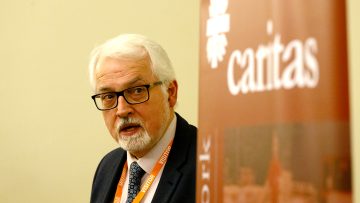
Professor Anna Rowlands, a theologian and Professor at Durham University, was one of the speakers at the presentation, alongside Cardinal Víctor Manuel Fernández, Prefect of the Dicastery for the Doctrine of the Faith; Cardinal Michael Czerny, SJ, Prefect of the Dicastery for Promoting Integral Human Development; Christopher Olah, Co-Founder of Anthropic and Head of Research on AI interpretability; and Professor Leocadie Lushombo, Professor of Political Theology and Catholic Social Thought at the Jesuit School of Theology of Santa Clara University in California.
Following the launch event, Professor Rowlands reflected on this significant day and what it means for the Church and for the world.
“The day has been pretty exciting, intense and momentous, as you would expect. This is the first time that a Pope has attended in the modern era, at least, the launch of a papal encyclical. Today there was a sense of a really important issue and set of topics being addressed, but also of a real gathering together with a spirit of appropriate celebration of a text that I think is a gift to the world.”
Turning to the encyclical, Professor Rowlands noted that Pope Leo has been focused on AI as a central issue since the beginning of his papacy. She explained:
“I think he genuinely feels that we’re living on the cusp of a new phase of the industrial revolution, and that we’ve entered a new moment where those same issues, in an intensified way, are now present to us again.”
Describing the urgency with which Pope Leo is approaching the topic, she said:
“[The Pope] thinks that this is an issue we should have been thinking about yesterday, and I think he worries, genuinely, that people don’t feel confident to tackle the AI conversation. He wants people to feel confident; their expertise doesn’t need to be in science or tech to engage with this issue. We do need the people with those bodies of expertise, but we are experts in humanity. We know what it is to inhabit a human body, to desire real human relationships rather than mere artificial connection with each other.”
The central focus of Magnifica humanitas is the dignity of the human person, and the need to ensure “the genuine flourishing of human beings.”
Professor Rowlands explained that an important aspect of this is nurturing a culture of encounter and engaging in meaningful dialogue within and across faith-based and secular groups, such as in the environmental sector.
“Certainly this is a significant voice in terms of the papacy, but there are others who already are and want to be part of that conversation. This is a moment where the Catholic Church is saying, ‘Us too.’ Today was a beginning of that process of a dialogue, but it also means a dialogue with those whose lives are most affected by the reality of a time of AI.”
During the morning’s event, Professor Rowlands stated that “Magnifica humanitas empowers us all to play our own part.”
Reflecting further on how Magnifica humanitas can be applied in our daily lives, Professor Rowlands explained how the vision which Pope Leo expresses in the first part of the document is complemented by a focus on concrete issues in later sections.
“Magnifica humanitas reminds us that we’ve got a landscape of principles and a narrative of what it means to be human as a created being and a redeemed being. We don’t need false idols and false accounts of other things that will save us, including AI; technologies are a part of created human life, but we keep them in place as technologies and tools; we don’t anthropomorphise them. What role do we want them to have in our families, in our churches, in our, in our schools, in our workplaces? That is a conversation where we should feel empowered to say if we will support this tech or not. If we lose that freedom to choose whether we allow this into our lives, then we’ve done something fundamental to the nature of human freedom.”
“The emphasis of the document is on asking what it means to live in a time where AI, digitalisation and robotics are already changing the landscape that we live in, how we live, how we love, how we work, how we share, and how we care.”
Watch the full interview with Professor Anna Rowlands, embedded above, or on YouTube, here.