Today, the world population is over 8 billion people and more than one billion people, or approximately 15 per cent of the world's population, live with some form of disability; 80 per cent live in developing countries.


3 December 2026
The annual observance of the International Day of Disabled Persons was proclaimed in 1992 by United Nations General Assembly resolution 47/3. It aims to promote the rights and well-being of persons with disabilities in all spheres of society and development, and to increase awareness of the situation of persons with disabilities in every aspect of political, social, economic and cultural life.
Building on many decades of UN’s work in the field of disability, the Convention on the Rights of Persons with Disabilities (CRPD), adopted in 2006, has further advanced the rights and well-being of persons with disabilities in the implementation of the 2030 Agenda for Sustainable Development and other international development frameworks, such as the Sendai Framework for Disaster Risk Reduction, the Charter on Inclusion of Persons with Disabilities in Humanitarian Action, the New Urban Agenda, and the Addis Ababa Action Agenda on Financing for Development.
Evidence and experience shows that when barriers to their inclusion are removed and persons with disabilities are empowered to participate fully in societal life, their entire community benefits. Barriers faced by persons with disabilities are, therefore, a detriment to society as a whole, and accessibility is necessary to achieve progress and development for all. The Convention on the Rights of Persons with Disabilities (CRPD) recognizes that the existence of barriers constitutes a central component of disability. Under the Convention, disability is an evolving concept that “results from the interaction between persons with impairments and attitudinal and environmental barriers that hinder their full and effective participation in society on an equal basis with others.” [1]
While Christian teaching constantly affirms the unrepeatable and universal value of every person before God, people who live with an experience of disability tell a different story. Historically, their creative individual ways to know and express God have been marked by barriers, marginalisation, a theological undervaluing, and services that are exclusive. Presumptions, regarding potential and a capacity to know God, limits creative expressions of neurodiversity. In turn, the individual who lives with an experience of neurodiversity, can be considered within a more negative anthropology and theology. The emphasis is on their vulnerability rather than their value-ability, which suggests a persistent gap at work between doctrinal affirmation and theological practice. Situated at the intersection of culture, tradition and lived experience, the thesis examines how neurodiversity and disability might be better understood and valued within theological discourse and practice. Over the past twenty years there has been a persistent and conscientious effort to remove such barriers that exclude as well as revisit exclusive theology so as to affirm each person’s value-ability and facilitate a paradigm shift in theory and practice, all over the world.
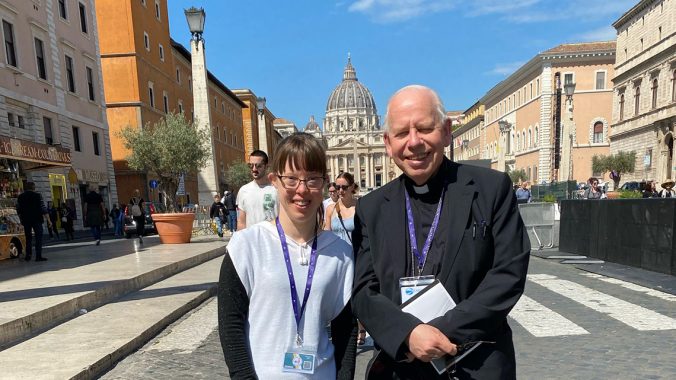
Bishop Paul Hendricks, an Auxiliary Bishop for the Archdiocese of Southwark, has recorded a reflection for the International Day of Persons with Disabilities, which falls on 3 December each year.

