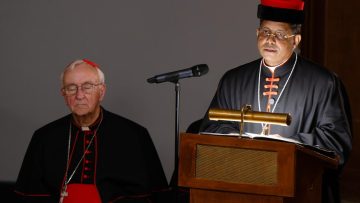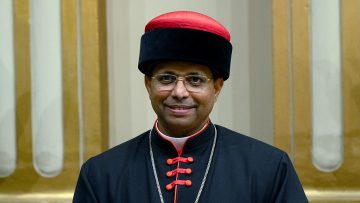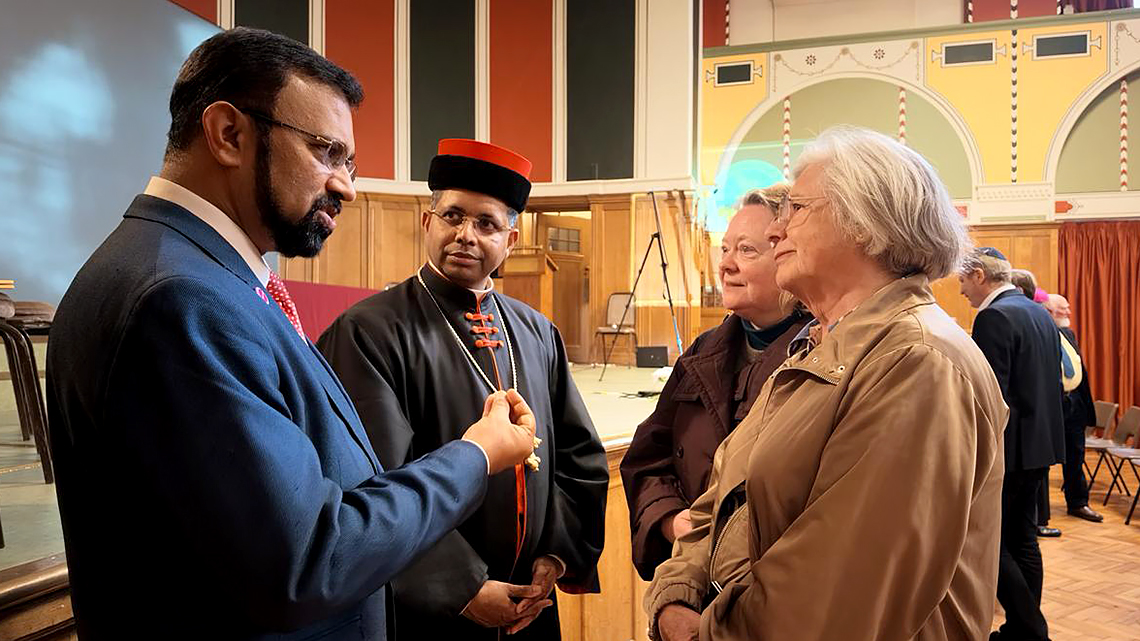
The visit of Cardinal George Jacob Koovakad, Prefect of the Vatican’s Dicastery for Interreligious Dialogue, continued on Sunday 18 October with the celebration of Mass in Westminster Cathedral, at which Cardinal Koovakad gave the homily, followed by an ecumenical gathering with Jewish representation at Westminster Cathedral Hall, titled ‘In Prayer for Peace’.
In his homily, Cardinal Koovakad observed: “In a world that is increasingly becoming multi-religious, the promotion of cordial interreligious relations is more necessary than ever.”
He reminded the congregation that genuine interreligious dialogue requires faith, love and hope from all sides.
“Cordial interreligious relations and collaboration are, therefore, a service to the whole human family. When people of different religions meet sincerely, they can overcome ignorance and prejudice, correct misunderstandings, and discover areas of common concern. They can work together for the peaceful resolution of conflicts, wars and violence.”
He went on to explain:
“The Church’s engagement in dialogue is not simply a matter of diplomacy or social politeness. It arises from the Gospel itself. Jesus teaches us to love God and to love our neighbour. The neighbour is not only the person who belongs to our own community or shares our faith convictions. The neighbour is the person whom God places before us to be loved and whose dignity we are called to recognise, respect and appreciate.
Reflecting on the cultural and religious diversity of the United Kingdom, the Cardinal concluded:
“Like other religious communities, the Christian community has an important responsibility in this situation. We are called to be communities that build bridges rather than walls, communities that welcome rather than exclude, and communities that sow the seeds of love rather than the weeds of hate. Our parishes, schools and institutions should be places where people learn that religious conviction, peaceful-coexistence and respect for others belong together.”
In the afternoon, an ecumenical reception took place with the title, ‘In Prayer for Peace’.
Representatives from the Armenian Orthodox, Syrian, Church of England, Methodists, United Reformed Church, Pentecostal, Salvation Army and Evangelical traditions came together with Jewish representatives to reflect on the importance of dialogue between these traditions and others in today’s world.
The gathering heard a video message from Cardinal Kurt Koch, Prefect of the Vatican’s Dicastery for Promoting Christian Unity. In it he stressed the urgent need for believers to speak out against antisemitism, anti-Christian sentiment, religious bigotry, and every form of violence.
We must “stand together to defend one another’s right to worship and live in safety,” he said.
“Our shared history shows we can move from strife and mistrust to reconciliation and friendship. Let us redouble that work now with deeds that match our words.”
Dayan Eliezer Zobin, dayan of the London Beth Din, expressed his thanks for the gathering in a context which is so challenging, and opened with powerful words recognising the grief which so many are facing today:
“Three years of grief after 7 October, the trauma of bereavement and hostage-taking, and the fear carried by Jewish communities… Compassion is not a limited fund, and recognising the grief of others does not somehow diminish our own.
“I want to recognise bereavement, displacement, loss of homes, and the fear that our Palestinian brothers and sisters feel, and in the context of our meeting today, recognise the fear, pain, and suffering of those who are part of the ancient Christian community in the land of Israel, and indeed the challenges these communities face across the whole of the Middle East.”
Reflecting on the day’s theme, Dayan Zobin explained:
“Shalom means peace. Etymologically, in Hebrew, Shalom is linked to Shalem, which means a sense of wholeness, of completeness. It is teaching us that only with an inner completion can an external sense of peace be achieved.”
When we apply this to the context of our faiths and the world today, Dayan Zobin explained:
“The shared Hebrew root calls upon us to think of peace as more than just a pause in fighting or cessation in argument, but to think about the inner changes that we need to make.”
He concluded:
“Peace and truth can never be achieved by preaching, because that negates people’s lived experiences and complexities. We can only achieve it by living, by modelling, by translating into action how we and the flocks that we speak to greet each other, interact.
“Peace can’t be spoken about; it can only be lived. If we talk to others outside our communities but don’t translate it into concrete steps, and actions for ourselves, then we can’t begin changing the world. Only if Shalom, peace, starts with Shalem, with that inner sense of self-compassion and an ability to understand what we’re fearing, what we’re experiencing, what we need, can we create the space to start interacting with others.”
Cardinal Koovakad thanked Dayan Eliezer Zobin for his words and expressed his gratitude for this important gathering.
The Cardinal opened by stating that:
“Prayer remains an indispensable tool for peace. It is the starting point where the God of Peace evokes in us sentiments, actions and decisions that favour peace. We may be already praying for peace in our communities and families, but our present-day world scenario calls ‘for an increase of prayers, since peace is above all a gift of God, a gift to be implored incessantly.’”
Reflecting on the theme of today’s gathering, he said:
“Our being in prayer for peace wherever we are – in keeping with our faith traditions – besides enhancing our unique beauty in diversity, unites us in fellowship as brothers and sisters in reference to the ‘one God and Father of all, who is over all and through all and in all.’”
Cardinal Koovakad concluded his reflections by encouraging all people of faith and goodwill to act together. He turned to the words of Pope Leo XIV’s Catechesis on the 60th Anniversary of Nostra Aetate, given in St Peter’s Square on 29 October 2025:
“More than ever, our world needs our unity, our friendship and our collaboration. Each one of our religions can contribute to alleviating human suffering and taking care of our common home, our planet Earth. Our respective traditions teach truth, compassion, reconciliation, justice and peace. We must reaffirm service to humanity, at all times.”
A prayerful two-minute silence was followed by an address by Rev. Dr. Nathan Eddy, Co-Director of the Council for Christians and Jews, who reflected on the relationship between Christianity and Judaism since Nostra Aetate.
Rev. Dr. Eddy expressed the importance of dialogue between Christians and Jews as well as the importance of the dialogue between Christians and those of other religions.
He recalled the “exceptionally close, unique, and lasting relationship with Judaism” and explained that, “by affirming God’s ongoing faithfulness to the Jewish people, Christians can encounter God through dialogue with them.”
Rev. Dr. Eddy reminded the audience that “when we commit to walking in peace today, and when we remember Nostra Aetate, it’s worth remembering the true horrors of the age that its vision of hope emerged from.”
Reflecting on today’s own “hugely challenging” times, Rev. Dr. Eddy said:
“In that context, we need people of goodwill like us gathered here for peace, and the moral authority of the Roman Catholic Church now more than ever.
“We can’t let these visions of peace cease in our day. As a society of many faiths in the UK, we must learn to articulate ways of toleration and community cohesion. And just as pressingly, we Christians need again to articulate religious values, as did Nostra Aetate, that state unequivocally how people of other faiths can be a blessing for the church – and how the church can be a blessing for others.”
Cardinal Koovakad will engage in fraternal visits to the Hindu, Jain and Sikh communities from Monday 19 October to Wednesday 21 October.