Tuesday’s events centred on Jain-Christian dialogue, with the theme, “Together to promote ‘Ahimsa’ (non-violence) for peace in the world”.


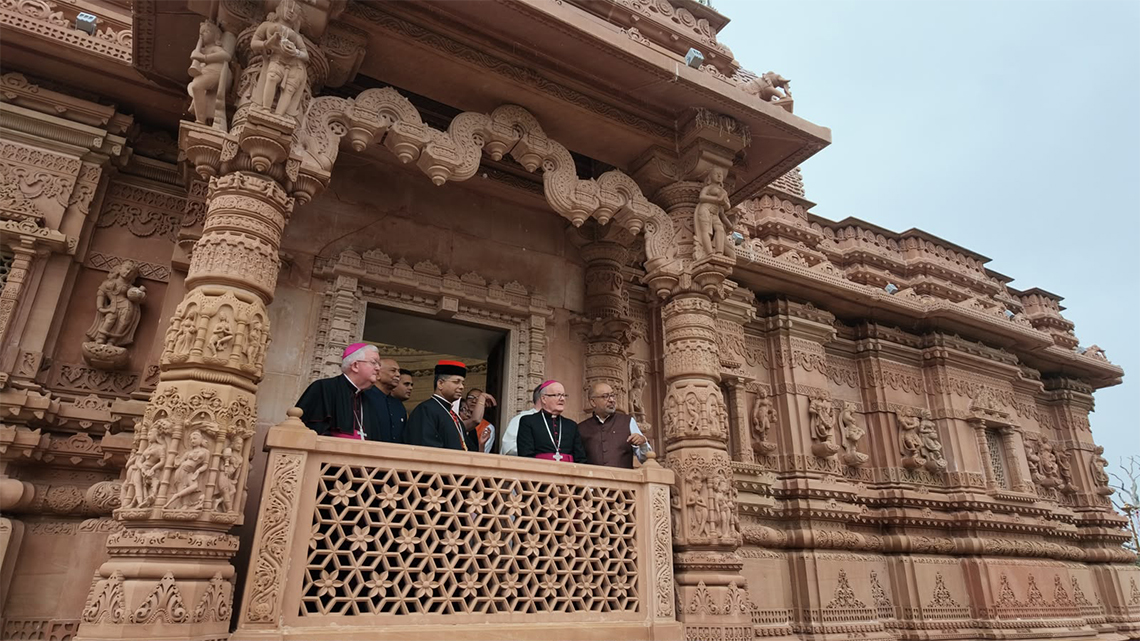
Tuesday 20 October marked the penultimate day of Cardinal George Jacob Koovakad’s visit to the UK. The Cardinal, who is Prefect of the Vatican’s Dicastery for Interreligious Dialogue, is undertaking his first official Church visit to the UK to meet with the Dharmic faiths.
Tuesday’s events centred on Jain-Christian dialogue, with the theme, “Together to promote ‘Ahimsa’ (non-violence) for peace in the world”.
The day began with a visit to a Jain Derasar (temple) at the Oshwal Centre in Potters Bar, the first traditional shikharbandhi Jain temple in Europe.
The Cardinal was welcomed at the temple by representatives of the Jain community and was invited to participate in a traditional lamp lighting ceremony.
There was an exchange of greetings and prayers, including for the health and recovery of Pope Leo XIV following his surgery last week.
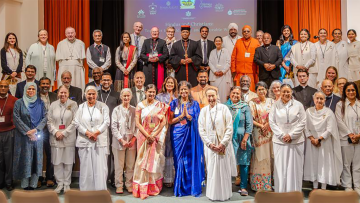
Following the temple visit, a conference took place, co-hosted by the Catholic Bishops’ Conference of England and Wales and the Institute of Jainology, during which the theme of non-violence was explored through a series of speeches and panel discussions. Themes included artificial intelligence, non-violence as a path to inner peace and interreligious dialogue as a means for promoting non-violence.
The meeting opened with the offering of felicitations to Cardinal Koovakad, Archbishop Bernard Longley and Bishop Patrick McKinney, who also participated in a traditional lamp lighting ceremony with Dr Mehool Sanghrajka, Managing Trustee Institute of Jainology, Mr Dilip Shah, Treasurer, Institute of Jainology, and representatives from the Hindu, Zoroastrian and Muslim faiths.
Cardinal Koovakad gave a keynote address, which he opened by offering “heartfelt thanks” for the gracious welcome he received.
“In an age where violence, in many and varied forms, has become a major concern in many parts of the world,” the Cardinal said, the day’s theme “is not only relevant but also imperative for both the Jains and Catholics so as to contribute together for the cause of peace in the world.”
The Cardinal focused on Christianity and Jainism’s shared “foundational commitment to love and non-violence”, highlighting Jesus’s “unconditional love for humanity” as a prime example of this in Christian teachings.
Recalling Pope Leo’s call for a “disarmed and disarming peace”, Cardinal Koovakad also reminded the conference delegates that:
“Our hopes and dreams for a peaceable world free of tensions, conflicts and violence can be achieved only through the path of dialogue, non-violence and fraternity.”
A prominent topic which arose throughout the day was artificial intelligence and its potential for creating a culture of non-violence.
Cardinal Koovakad also reflected on this, saying:
“While we reflect on ‘Ahimsa’ for peace in the increasingly weaponised world that we live in, an ever-increasing influence and unbridled use of artificial intelligence can become a huge challenge to peace in our world.
“Knowing this extremely dangerous situation, the Holy Father Pope Leo XIV has published a landmark encyclical Magnifica Humanitas (‘Magnificent Humanity’) which warns against technocratic dominance, autonomous weapons, and algorithmic injustice, while affirming human rights, solidarity, and the civilisation of love.”
Dr Mehool Sanghrajka, Managing Trustee, Institute of Jainology, who led the organisation of the conference, said:
“The conference reaffirmed the shared commitment of Jains and Christians to ahimsa, compassion and peace. We agreed that by speaking with a united voice and actively engaging with global challenges, we can help shape a stronger moral and ethical framework for a more peaceful and compassionate world. We are deeply grateful to the Dicastery for Interreligious Dialogue for their partnership and commitment to this shared vision.”
The panel discussions were led by Jain, Christian and other representatives, and panellists included Bishop Paul Hendricks, Auxiliary Bishop of Southwark and Lead Bishop for Artificial Intelligence for the Bishops’ Conference, Lord Krish Raval, Member of the House of Lords, Dr Giulio Corsi, Research Associate at the Leverhulme Centre for the Future of Intelligence, University of Cambridge, Samani Pratibha Pragya, Jain nun and Visiting Professor at Florida International University, Fr Dominic Robinson SJ, a university chaplain and member of the Bishops’ Conference Department for Dialogue and Unity, Elliot Vanstone, Mission Advisor, Catholic Bishops’ Conference of England and Wales, and Shandip Shah, Institute of Jainology.
Cardinal Koovakad’s visit concludes on Wednesday 20 October with the third of his fraternal visits to the Hindu, Jain and Sikh communities.
The day, which had the theme, ‘Hindus and Christians: Together to build a just and peaceable world’, began with a visit to the BAPS Shri Swaminarayan Temple, also known as Neasden Temple, in northwest London.
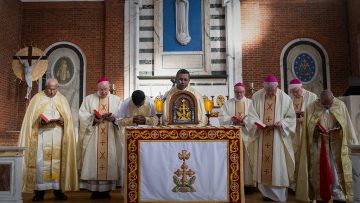
Representatives from the major world religions gathered in London on Saturday 17 October to sign a pledge to work together for peace.

The Cardinal visited a number of religious places of worship to offer prayers for peace in their different traditions and to encourage them to work together for the common good and for a more peaceful world.
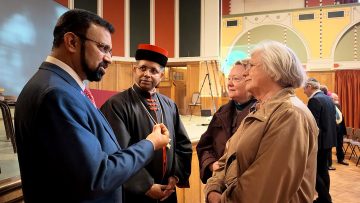
The visit of Cardinal Koovakad continued on 18 October with the celebration of Mass and a gathering of ecumenical and Jewish representatives.

