The synodal process is continuing to take root and steadily progressing across the universal church.
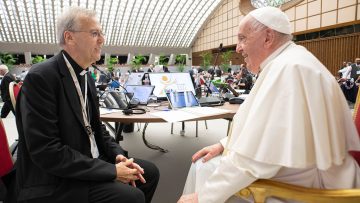
In his concluding homily at the recent Jubilee of Synodal Teams, Pope Leo said:
“Synodality is about synodal teams and other participatory bodies working out of a logic not of power but of love. It is about … everyone listening to the other.”
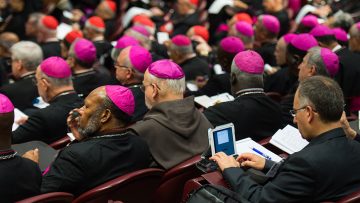
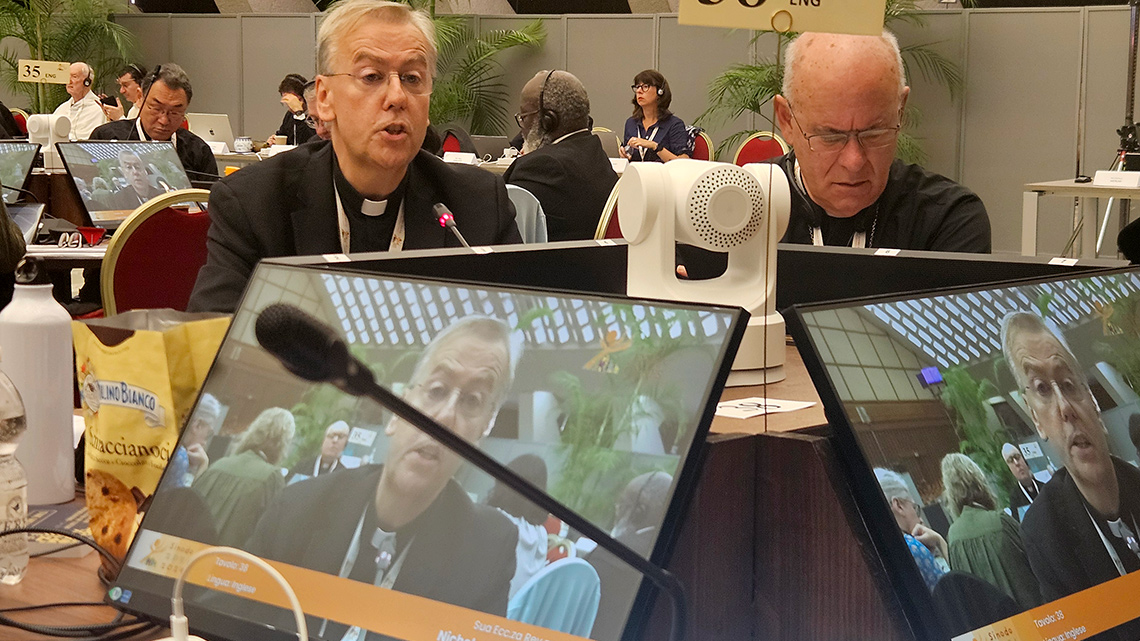
In this spirit, at the recent autumn plenary meeting of the Bishops of England and Wales, a synod update was given by the three bishops who attended the two sessions of the 16th Ordinary General Assembly of the Synod on Synodality – Archbishop John Wilson, Archbishop of Southward, Bishop Nicholas Hudson, Bishop of Plymouth, and Bishop Marcus Stock, Bishop of Leeds.
The bishops also discussed the Synod document ‘Pathways for the Implementation Phase’, which offers a suggested framework for this stage of the Synod process, to be examined by local Churches according to their various and diverse contexts.
In the week following the bishops’ plenary meeting, the General Secretariat of the Synod published the interim Reports of the Synod Study Groups, which was established by Pope Francis in March 2024.
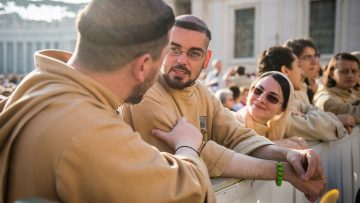
Bishop Hudson and Bishop Stock attended the recent Jubilee meeting of Synodal Teams which took place in Rome from 24 to 26 October 2025.
Speaking of his experience, Bishop Hudson said:
“We were encouraged to find ourselves part of a 2,000-strong pilgrimage, including some 30 pilgrims from England and Wales representing at least eight dioceses.
“Pope Leo contextualised the synodal journey through the primary lens of ‘mission and being missionary’. In this sense, each local Church – each diocese and eparchy – is working with the pathways as proposed in the implementation document as ‘part of the General Secretariat’s service of accompaniment during the implementation phase of the Synod.’
“What came over most strongly was the message that synodality is, at heart, a spirituality of listening and formation – formation in listening, in the use of ‘Conversations in the Spirit’, in the discernment of baptismal charisms. The sense participants took away from this memorable pilgrimage was that we are being encouraged to understand synodality first and foremost as a culture – nothing less than a culture of communion.”
The timeline proposed for the implementation phase suggests a further 12 months, until the end of 2026, for implementation paths in local churches ahead of evaluation assemblies in dioceses and eparchies during the first half of 2027.
Following the autumn plenary meeting, the Bishops of England and Wales reaffirmed their commitment to the processes of listening and discernment which embody synodality, working closely with the clergy and lay faithful in their dioceses.
The Pathways document states:
“Precisely because this is an ecclesial process in the fullest sense of the term, the first person responsible for the implementation phase in each local Church is the diocesan or eparchial Bishop … This will be an appropriate opportunity to exercise authority in a synodal way.”
In a spirit of subsidiarity and synodality, and following this guidance set out in the Pathways document, implementation will progress at a different pace, and in different ways, in each diocese.
The Pathways document continues:
“Bishops are called to encourage and support the participation in the synodal process of all the members of the portion of the People of God entrusted to them.”
In his homily at his Mass of Installation as the new Bishop of Plymouth, Bishop Hudson echoed this and highlighted the co-responsibility among clergy and the laity for ensuring the continuation of the synodal process.
He said:
“The key to knowing how we do it, how we organise ourselves to welcome, the latest Synod was clear, is to deepen our listening. Deepen our listening? Yes, that we need to deepen the quality of our listening to the Spirit, to one another, and to our context; our listening to every generation in the Church – but with a special attentiveness to the young, to the poor, to the marginalised, to those who stand on the outside looking in.”
Synodal updates, sharing of experiences and learning will continue to be a feature of the bishops’ plenary meetings throughout the implementation phase.