Shaping Synodality in Europe: From Vision to Roadmap
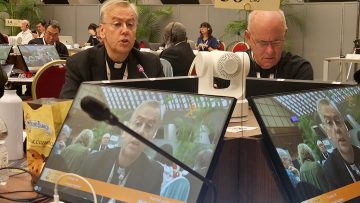
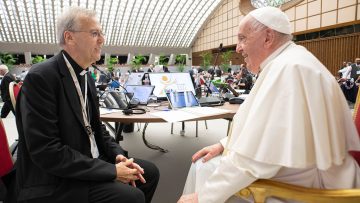
Delegates from across Europe gathered from 14-17 September 2026 in Bildungshaus Schloss Puchberg, an adult education centre in Wels, Austria, for a symposium on synodality organised by the Council of European Bishops’ Conferences (CCEE).
The symposium was hosted by CCEE in partnership with the Research Group of the Department for Synodality at the Catholic Private University Linz and the European Taskforce of the CCEE.
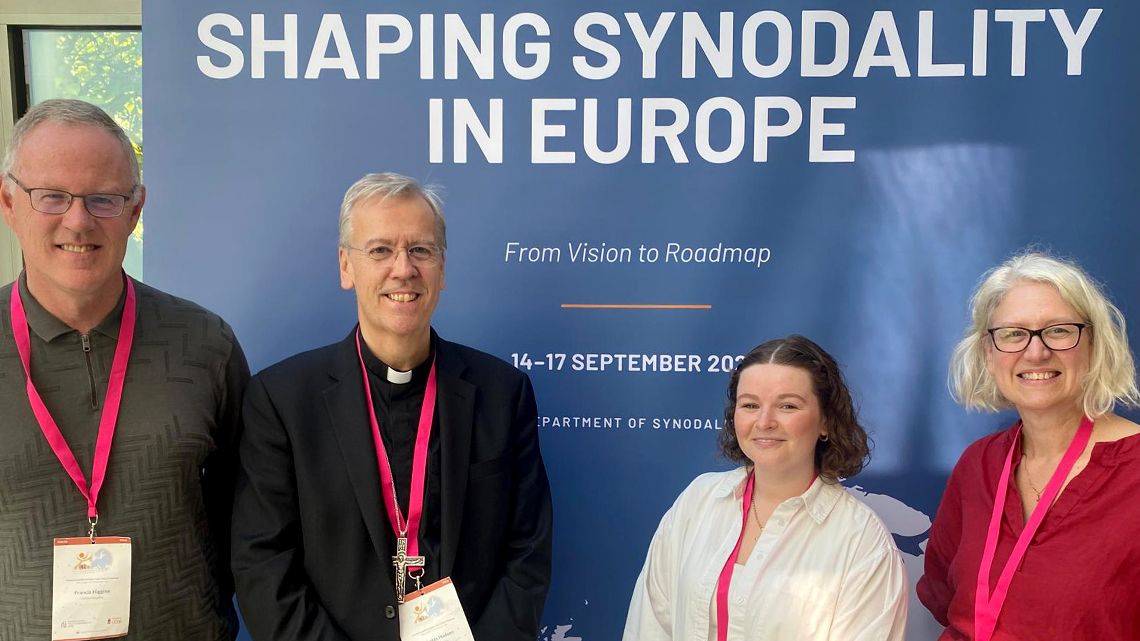
Representing England were Bishop Nicholas Hudson, Fr Francis Higgins, Alex Shelton-Bourke and Avril Baigent.
Bishop Hudson, the Bishop of Plymouth, reflects on the key themes, discussions and insights that emerged during the Symposium.
“The Bishop of Plymouth, England, from the far West of Europe; the Bishop of Kamyanets-Podilskyi, Ukraine, from the far East: you stand either side of me.” So, the Archbishop of Vilnius kindly instructed us as he chose bishops to concelebrate with him at the morning Mass. By that choice he sought to capture the breadth of this meeting: 180 people representing 31 countries and 29 Bishops’ Conferences from right across the European continent gathered in Wels, Austria, for a symposium on Shaping Synodality in Europe.
The Council of European Bishops’ Conferences created a year ago a European Task Force to prepare for the Continental stage of the European Ecclesial Assembly scheduled for spring 2028. The Continental represents a still further stage in the process of the Synod on Synodality, with diocesan and national assemblies scheduled to precede it. The symposium is the first event which the Task Force have organised to prepare the ground for the European Assembly. Keynote speakers include Professor Tomas Halik of Prague University; Sister Nathalie Becquart, Undersecretary of the General Secretariat of the Synod of Bishops; and Professor Myriam Wijlens of Erfurt University
A love for Europe is what has communicated itself most powerfully – just as it was a love for the Church which first revealed itself at the launch of the Synodal process in England and Wales. A stress on the community of all the baptised in Europe has given a thoroughly ecumenical thrust to the Symposium. The presence, from the ecumenical community of Taizé, of both the Catholic ex-Prior Brother Alois and the English Anglican Prior Brother Matthew underline the ecumenical vocation of Synodality in Europe.
The vocation of a Synodal Church in Europe best captures the spirit of the symposium. Pope Leo’s description of Synodality as “a culture of listening” finds strong resonances in the conviction of speaker after speaker of the need to listen – to listen deeply to the community of all the baptised, to listen to those who stand outside the Church, to listen to Europe’s increasingly secularised society and culture.
The Symposium recalls successive Popes’ call to a New Evangelisation addressed to three categories of people – those who already belong, to those who no longer belong, and to those who have never belonged. Tomas Halik urged us as Church to be sure we answer questions people are asking within each of these categories The priority of relationships – of ecclesial accompaniment – was underlined. In a Europe torn apart by war and increasingly defined boundaries, a Synodal Church has prophetic potential in the call it makes to communion and a striving for consensus.
“We remain a part of the Church in Europe,” was the constant reassurance I offered brother-bishops of the European Union as we prepared, a decade ago, for the possible departure of the United Kingdom from the EU. The welcome extended to the four of us who had come to Wels from England – myself, Avril Baigent from The School of Synodality, Alex Shelton-Bourke and Fr Francis Higgins from Northampton Diocese – confirms the impression of England and Wales being very much a part of the Church in Europe.
The Symposium has served to deepen our anticipation of the Synod’s implementation in England and Wales. I am confident that the papers which will be forthcoming from this gathering will deepen the sense of the potential that a truly Synodal Church has to transform – to transform not only the Church but also those who stand on the outside looking in, right across this continent.
Right Reverend Nicholas Hudson
Bishop of Plymouth