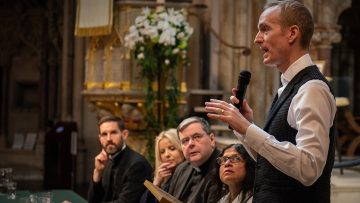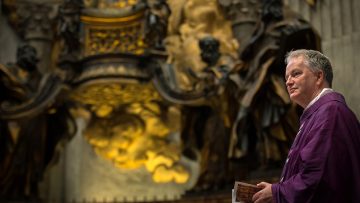
In a recent interview with Radio Maria, Bishop Paul Hendricks, Lead Bishop for Artificial Intelligence for the Bishops’ Conference, spoke about the ethical questions which AI raises and shares how the Catholic Bishops’ Conference of England and Wales is engaging with technological developments.
Recognising the rapid progression of AI, Bishop Hendricks explained that while it isn’t yet possible to share a definitive Bishops’ Conference policy, it is nonetheless important to be part of the conversation, especially given the ethical concerns which AI raises. He explained:
“Artificial Intelligence raises some very important ethical and philosophical questions. These aren’t only about the ways that it impacts upon individuals and society. AI also has implications for how we think about ourselves and what it means to be human. As Catholics, we have inherited a great tradition of theological and philosophical reflection, which helps us understand some of the more fundamental issues that are at stake in relation to AI.”
While there are risks, AI also has great potential for good.
“Artificial intelligence, like so many human creations,” Bishop Hendricks said, “is a tool: whether it is good or bad depends on how it is used.”
Bishop Hendricks explored some positive uses of AI, including school lesson planning which could be customised for the abilities of individual students, as well as the development of medicines and treatments for rare medical conditions.
However, there are also associated risks, as Bishop Hendricks explained:
“Talking of education points to one danger known as ‘de-skilling’. If students use AI to write their essays, they may succeed in getting good marks with little effort – but they won’t have learned anything. By letting AI do all the work, they’re failing to develop the skills that the schoolwork is supposed to be promoting.”
How does one address the risks and dangers of AI?
Bishop Hendricks suggests that it is of crucial importance that people are taught to understand and use AI properly, especially by ensuring that they understand its potential risks and pitfalls.
In particular, Bishop Hendricks raised the issue of bias and the risks that this could involve when using AI in healthcare, for example.
“AI is trained on data that has been built up over many years. If there are biases in that data, then this will be reflected in the results. Historically, most medical research has been done in Western countries, with majority white populations. This means that the results of AI based on that data is liable to be less accurate for other ethnic groups.”
Understanding the way AI works will enable us to use it to its best potential.
“Like any tool, AI can make the job easier, but only if we have learned how to use it in the right way. We can’t expect it to do all the work for us.”
Bishop Hendricks reflected on how the teachings of the Church can help us to navigate our way through these evolving technologies and their impact on our lives. He explained:
“One question concerns the very concept of Artificial Intelligence. AI produces results that look like those of human intelligence and that can lead us to think of a chatbot as being similar to a human being. We can even find ourselves relating to it as if it were a real person. However, though a chatbot may speak in a way that makes it appear to be a real person – but, in fact, it isn’t.”
Bishop Hendricks reflected on recent distressing cases where treatment of AI like a real person has had severe consequences, including, sadly, cases where people have died. This is where the ethical implications of AI are most urgent, and Bishop Hendricks posed the important question: “Who is responsible?”
Bishop Hendricks suggests instead that:
“Genuine psychological and spiritual growth comes from learning to live with real people, who do unexpected and sometimes annoying things. Growing in our ability to love means making allowances for the needs of others, seeing things from their point of view, and sometimes making sacrifices for their sake. None of this can happen from interaction with a chatbot.”
He went on to explain that the Church has always engaged with new technological developments; for example, Pope Leo XIII who responded to social changes caused by industrialisation. Central to the Church’s approach is “trying to see what is good as well as what needs to be challenged.”
There are many questions still to be asked about the use of AI and its impact on humanity. Bishop Hendricks concluded that a spirit of collaboration and openness will be crucial as we continue our exploration of emerging technologies in today’s world.
“The Church recognises the importance of engaging with AI in a positive way, and it has a major contribution to make. The wide impact that AI is already having, and its huge implications for the future, mean that we will need the insights of people of many backgrounds and expertise, working together to make AI a real opportunity for mankind, and not the threat that it sometimes appears to be today.”