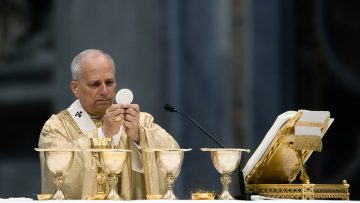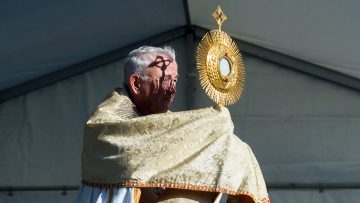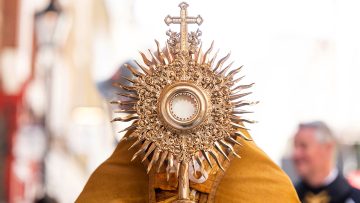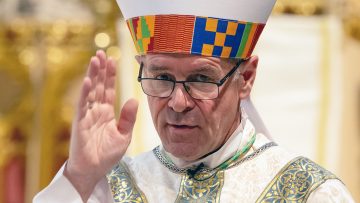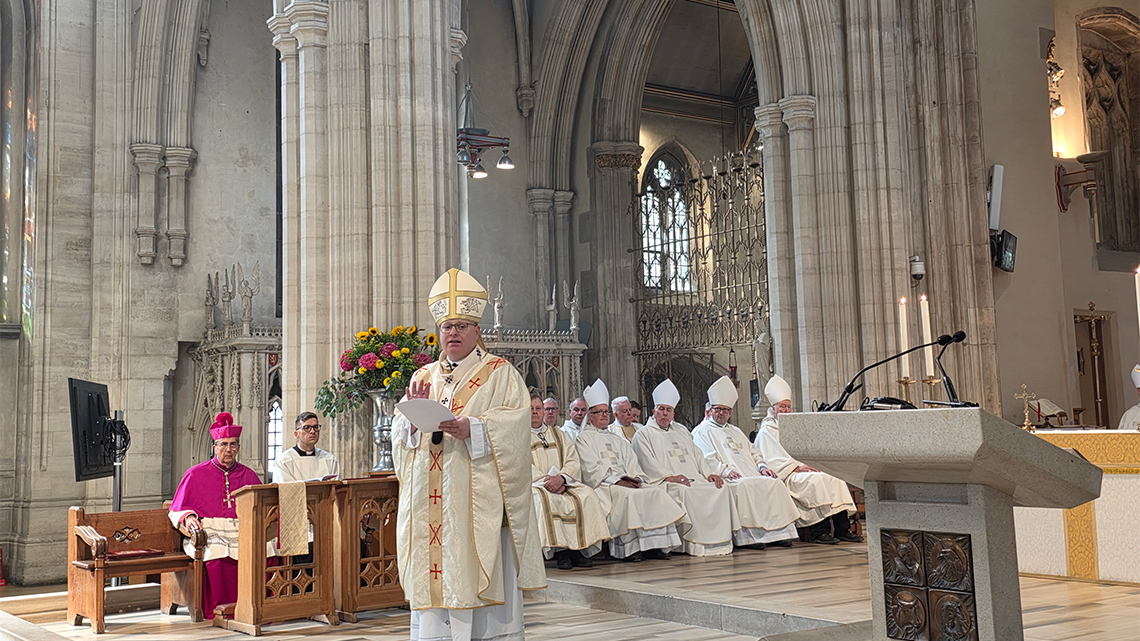
Homily given by Archbishop John Wilson for Adoremus 2026 at Southwark St George’s Cathedral on Saturday 10 October 2026.
Dear brothers and sisters in Christ
On this joyful day, there is a question in my heart. It’s this: How deeply do we believe in the converting power of the Eucharist? How deeply do I, how deeply do you, believe in the power of our Eucharistic Lord to touch people’s lives?
Some years ago, I was introduced to the life and work of Takashi Nagai, a Japanese physician, victim of the atomic bomb on Nagasaki, and convert to Catholicism. He died from leukaemia in 1951 aged 43.
Takashi’s conversion came through various factors, but decisive among them was the first time he attended Holy Mass in 1932. As a non-believer, Takashi lodged with a Catholic family while studying medicine in Nagasaki. The family invited him to spend Christmas with them and encouraged him to join them for Midnight Mass, quietly praying that he might encounter Christ. “But I am not a Christian,” replied Takashi. The wise father of the family responded, “That doesn’t matter. The shepherds and the Magi who came to the stable were not [Christians] either. But when they saw him, they were able to believe.”i
“When they saw him, they were able to believe.” The father’s faith was expectant: when you see the Eucharistic Jesus, then you will be able to believe. These are powerful words of faith to hear as we carry the Lord Jesus present in the Blessed Sacrament through our streets. Are we praying today – and do we pray in our families, parishes, schools, and chaplaincies – for people to encounter Jesus through his Eucharistic presence? I hope so.
Takashi went to Mass. He described his ‘unexpected “intuition that there was a living Someone present in…Urakami Cathedral.”ii Attending the Eucharist for the first time he encountered a “living Someone” he did not yet know, but whose presence he experienced. Eighteen months later, Takashi was baptised and took the Christian name Paul.
This account of Eucharistic conversion inspires me. I ask myself how I consider Jesus a “living Someone” when I come to Mass or enter the presence of the Blessed Sacrament, Jesus who is the living bread, come down from heaven. What confidence do I have – what confidence do we have – in the power of our Eucharistic Lord to convert hearts to himself? Do we pray for this grace in our lives and in the lives of others?
A recently ordained priest in our Archdiocese told me of his visit to a young man in a secure health facility who asked to receive the Eucharist. When the priest held up the Sacred Host and said “Behold, the Lamb of God…,” the young man responded, “Please, may I just look at him for a moment?”
Despite serious challenges, that young man knew the Eucharist was not a thing, not an ‘it,’ but a someone; the living, real and true sacramental presence of the Lord Jesus Christ. “Please, may I just look at him for a moment?” Him who gives his flesh as true food. Him who gives his blood as true drink. Today, in the most Blessed Sacrament, we look upon Jesus as he radiates his love.
Since the beginning of the Church, the Eucharist instituted by the Lord Jesus, and entrusted to the Apostles, has been the well-spring and pinnacle of Catholic faith and practice. We only have to read the Acts of the Apostles, chapter 2 verse 42, to see the first Christians gathering on Sunday, the day of the resurrection, for the Eucharist, the Breaking of Bread.
The Church’s ancient Eucharistic faith is captured in the catechesis of St Cyril of Jerusalem around the year 350 AD when he wrote: “Since [Christ] Himself declared and said of the Bread, ‘This is My Body,’ who shall dare to doubt any longer? And since He Himself affirmed and said, ‘This is My Blood,’ who shall ever hesitate…?”
This truth inspired St Thomas Aquinas to spell out the essence of Eucharistic faith in the Adoro te devote, his Eucharistic hymn, translated by the English Jesuit Gerard Manley Hopkins: “What God’s Son has told me, take for truth I do; Truth himself speaks truly or there’s nothing true.”
“This is My Body,’ ‘This is My Blood’- “Truth himself speaks truly or there’s nothing true.”
Like many dioceses across England and Wales, we have noticed an increase in people seeking to join the Catholic Church as catechumens and candidates.
Emma, an artist and former agnostic, was asked by a Catholic friend to paint a picture of Jesus. This ignited her desire to learn more about the Catholic faith. “My relationship with Christ has grown deeper,” she said; “I just feel at peace at adoration … Christ brings a wholeness that you’ve been searching for your whole life Zach was invited by a Catholic friend to attend a Corpus Christi procession. “The gears began to tick in my head,” he said. Encountering the Real Presence of Christ in the Eucharist was the turning point, a “life-changing experience.” Zach describes how “Seeing the procession, seeing the devout faith of all those people, was something else. To see so many people, so many young people, publicly profess their faith in such a way was beautiful.”
Dear friends, do we believe the grace of Eucharistic conversion is operative today; that it is actively present in our churches and chapels? If we do, it will change not only how we seek to encounter Jesus in the Eucharist, it will also change how we enable others to do the same. It will embolden us as Eucharistic evangelisers. Loving our Eucharistic Lord means wanting to spend time with him, laying our hearts bare before him. Loving our Eucharistic Lord means praying that others might encounter him and be opened to his presence.
Towards the end of The Story of a Soul, when St Therese of Lisieux’s life was coming to its close, she made an incredible act of faith. Speaking to Jesus she said this: “For me to love you as you love, I would have to borrow your own love, and then only would I be at rest.”iii For me to love you Jesus, as you love me, I would have to borrow your love to give me rest.
My sisters and brothers, if ever your brokenness makes it too painful for you to reach out in love to Jesus, then ask him to lend his love to you. Borrow your love from his Eucharistic Heart. Go directly to the words of the Adoro te devote:
O thou, our reminder of the Crucified, Living Bread, the life of us for whom he died, Lend this life to me then…
Lend this life to me.
We ask Jesus to lend us his Eucharistic life. And with his Eucharistic life in us, we set out to lend this life to others.
How deeply do we believe in the power of our Eucharistic Lord to convert hearts to himself? How earnestly are we praying that this will be the case?
i This is recounted in: Paul Glynn, A Song for Nagasaki – The Story of Takashi Nagai (San Francisco: Ignatius Press, 1988) 79.
ii Ibid.
Iii Therese of Lisieux, Story of a Soul: The Autobiography of St. Thérèse of Lisieux, trans. John Clarke, O.C.D. (Washington: ICS Publications, 1996) Manuscript C [35r].