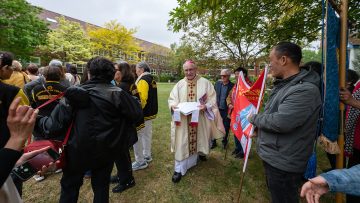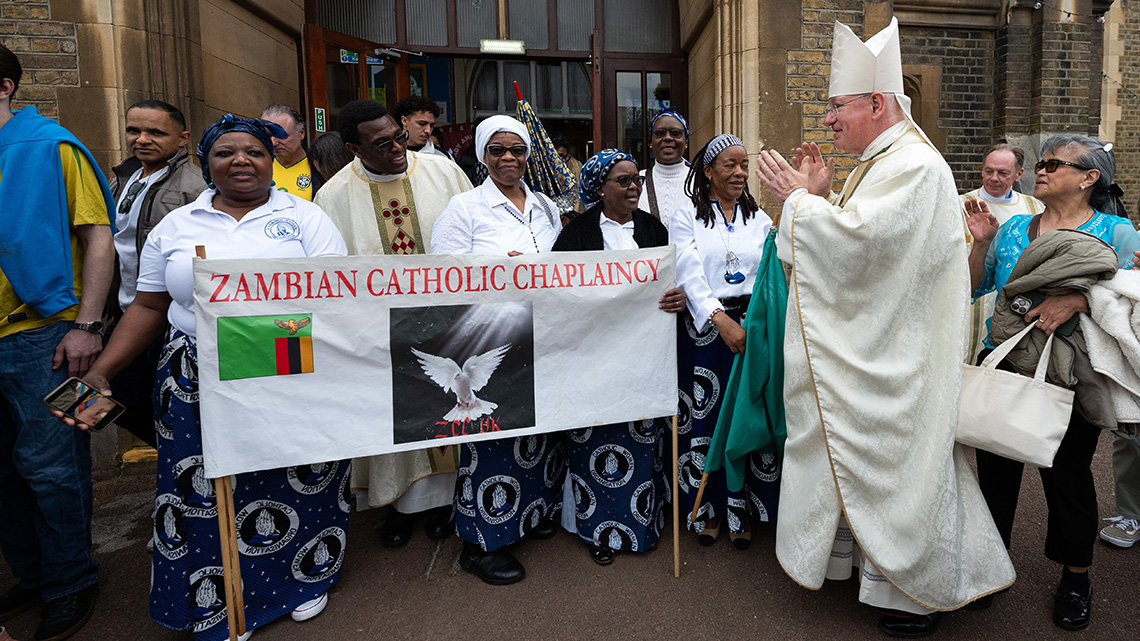
The 20th annual Mass for Migrants took place at St Antony’s Catholic Church in Forest Gate in East London on Bank Holiday Monday, 4 May. The vibrant celebration, jointly marked by the Dioceses of Brentwood, Southwark, and Westminster, started at midday with a procession of banners.
Preaching at his first Mass for Migrants as Archbishop of Westminster, Archbishop Richard Moth encouraged us to rejoice in the ‘freshness’ and ‘newness’ brought by those who travel to our countries.
“At a time when tensions in so many of our communities are seemingly more evident, I ask you to join with me in rejoicing in the freshness, the openness, the newness, and the expression of faith that we celebrate here today,” he said. “Let us rejoice in the richness of experience, culture, and faith that we see present in our communities.”
Archbishop Moth also stressed that the pursuit of peace goes hand-in-hand with the need to recognise the God-given dignity of humanity:
“Peace is something that is often fragile, and this is a consequence of the denial of the dignity of the human person. For when we view our brothers and sisters as threats or as enemies, they become devalued in our eyes. They become less than human. May we proclaim to the world around us the dignity of the whole of humanity created by God out of love in His own image and likeness. This is a vital part of the vocation we receive at our baptism and a necessary part of the mission to which Jesus has called us.”
You can read the full homily preached by Archbishop Moth below.
Dear brothers and sisters, our first reading today speaks to us of the beauty of all creation and of the particular and very special place that humanity has in that creation. God is complete in Himself – He does not need to create. His act of creation is an expression of love. This is seen more than anywhere else in the creation of humanity, in His own image and likeness.
We heard those words: “And God saw everything that He had made, and, behold, it was very good.” So as we look around the pews in this church, what do we see? We see goodness. The goodness of creation and the dignity of humanity created in nothing less than God’s image and likeness.
Rejoicing in this wonderful gift of God’s life, we recognise that we are people gathered from every nation across the face of the earth. It was wonderful for Bishop Paul McAleenan, Bishop Alan Williams and myself to meet with all those carrying banners before Mass. I was particularly pleased to meet with those carrying the banner from Zambia, because that’s where I was born.
Each of us might reflect, then, on the journey of our lives. Some of these journeys have been very difficult. A number in our church today may well have endured significant challenges and hardship along the way. Some of these difficulties have been lived privately – even hidden. For others, the journey may have been a bit more straightforward. Yet today we can rejoice in the faithful love of God our Father, who is always with us, no matter how difficult the journey may be.
The experience of life is something that we bring to the world in which we live. These experiences can help us in the service of our brothers and sisters. Today’s Gospel teaches us something very important about our communities. Jesus was not welcomed in his own community, in his own town. It was those from outside Nazareth who were open to His message. Those from other towns and villages had something to teach the people of Nazareth – openness to the newness of Jesus’ message.
It is in our own society, and today, that we rejoice in the freshness and the newness that all who travel to this country bring to us. At a time when tensions in so many of our communities are seemingly more evident, I ask you to join with me in rejoicing in the freshness, the openness, the newness, and the expression of faith that we celebrate here today. Let us rejoice in the richness of experience, culture, and faith that we see present in our communities.
Today, we celebrate the universality of the Catholic Church that we see so evident in our parishes. This universality enables us to understand the welcome that is natural to us. We see the dignity of every person, recognising in one another the beauty of God’s creation. The recognition of God’s beauty in one another is a gift that we must bring to our society and to our world, for it is the gift that models openness and welcome to a society, to a world, that in so many ways seems to be becoming less welcoming and less open.
Jesus’ first words after his Resurrection were, “Peace be with you.” The reminder of this gift formed the first words that Pope Leo said after his election as the successor of Peter. When he came onto that balcony at St. Peter’s, his first words were, “Peace be with you.” This is a message that our Holy Father continues to proclaim to the world with gentle yet clear insistence. Peace is something that is often fragile, and this is a consequence of the denial of the dignity of the human person. For when we view our brothers and sisters as threats or as enemies, they become devalued in our eyes. They become less than human.
May we proclaim to the world around us the dignity of the whole of humanity created by God out of love in His own image and likeness. This is a vital part of the vocation we receive at our baptism and a necessary part of the mission to which Jesus has called us. This is a sure way to peace in our homes, our communities, our places of work and our schools, our wider society, and indeed the whole world. It is nothing less than the proclamation of the peace given us by the Risen Christ. Each and every one of us, from wherever we may come, join together in our wonderful communities to proclaim that message of peace.