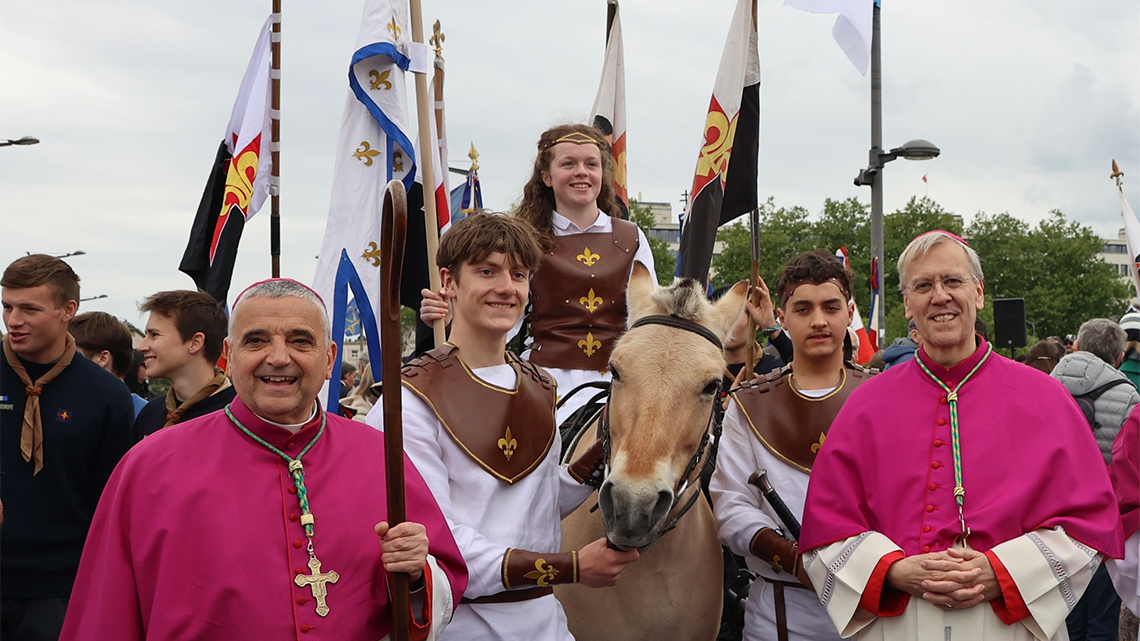
The Saturday following the Ascension marks the annual celebration of Saint Joan of Arc in Rouen, France. Every year, the Archbishop of Rouen invites a guest preacher. The last Englishman to have been invited was Archbishop George Patrick Dwyer of Birmingham in 1967.
This year, the Bishop of Plymouth, the Right Reverend Nicholas Hudson, was invited to preach. Bishop Hudson, who is British and French, spoke of how English Catholics love and revere, the affectionally known, Saint Joan of Arc. As a former Auxiliary Bishop of Westminster, he shared that Westminster Cathedral itself bears a large, prominent mosaic raised to the honour of Blessed Joan of Arc in 1910, ten years before her canonisation, and that many churches across England are dedicated to her honour.
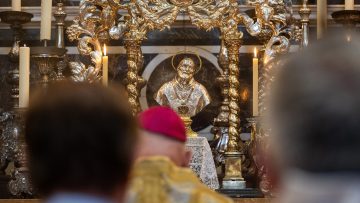
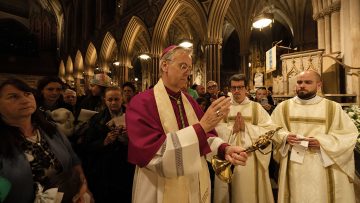
Bishop Hudson preached the morning homily at Mass in the church of Saint Joan which stands in the square where the nineteen-year-old was burned at the stake. Remarkably, the sanctuary was adorned with the 15th-century processional cross which Saint Joan asked to be held before her as she burnt. In his homily, Bishop Hudson reflected on the words of Mark Twain, who called Saint Joan of Arc, “by far the most extraordinary person the human race has ever produced.” He drew on the words of the Psalmist and the Wisdom of Solomon to retell her story, recalling how she was “though young, found keen in judgment” and “in the sight of rulers, admired.” He reflected on how “the pro-English clerics who put her on trial must surely have been impressed by her courage” in telling them, “You say that you are my judge. Take care what you do, for in truth I am sent by God, and you put yourself in great danger.”
Bishop Hudson spoke of how Saint Joan gave testimony to the teaching of Jesus – the call for any follower of his to deny himself, take up his cross and follow. “Every martyr,” he said, “knows what it means to take up their cross, and such was Saint Joan of Arc’s conviction of the Cross’s saving power that she asked to have a cross held before her as she submitted to the flames.” Everyone heard her cry “Jesus” as she took her final breath.
The Bishop also spoke of the deep distress Saint Joan of Arc experienced on discovering that, if she persisted in her recantation, she would be denied the life of the sacraments for the rest of her life. “She had recanted,” he said, “only because she knew and trusted her judges to represent the Church, and because she respected and wished to submit to the Church’s authority. But when she returned to her cell and was reproached by her voices for having denied God, she chose rather to submit to a higher authority – the authority of the voices she heard – even if it meant submission to the flames.” George Bernard Shaw paid Saint Joan of Arc the highest compliment when he suggested that in such a decision she “represented life possibly at its highest actual human evolution.”
Mass was followed by a civic ceremony in the Place du Vieux-Marché, the Old Market Square. After lunch, and to a full Cathedral, Bishop Hudson preached the half-hour Panegyric – a speech in honour of Saint Joan.
In his Panegyric, Bishop Hudson recalled the words of the distinguished English historian Helen Castor, that “in the firmament of history Jeanne is a massive star” whose “light shines brighter than that of any other figure of her time and place.” Her story, he recalled, is “unique and at the same time universal in its reach – a recurring motif replayed in art, literature, music, and film.” He drew on the accounts of distinguished judge and historian, Jonathan Sumption, to recall that it was Saint Joan’s persuading of both Dauphin and troops alike that made the coronation in Rheims possible and so altered history. “Her real weapons,” Sumption said, “were her charisma and her faith – her faith in herself and in her voices. Victory, she would tell her men, would come not from numbers, not from tactics, but from God himself.”
Bishop Hudson reflected on the witness of Pope Benedict XVI, who wrote that her holiness is “a beautiful example for lay people engaged in politics, especially in the most difficult situations,” and who described her prayer life as one of continual conversation with God – “the Name of Jesus,” Pope Benedict XVI said, “was like the continuous breathing of her soul.”
He recalled too the bond between Saint Joan of Arc and Saint Thérèse of Lisieux, brought together by the Church as Patronesses of France, and united by, as Pope Benedict XVI wrote, “the same great love for Jesus and her neighbour, lived in consecrated virginity.” Thérèse expressed her desire to die, like Saint Joan of Arc, with the Name of Jesus on her lips.
He recalled the words of Pope Benedict XV at her Canonisation on 16 May 1920 – 106 years ago to the day – that the English “had a mortal hatred for Jeanne and wanted her death at all costs,” and of how Pope Benedict XVI had written that her trial was “a distressing page in the history of holiness.” “This trial,” Jonathan Sumption suggests, “was not so much about the veracity of Jeanne but about the legitimacy of the dual monarchy – ultimately not a religious but a political condemnation.” The judges who condemned her, Pope Benedict XVI said, “lacked charity and the humility to see God’s action in this young woman.”
In the final words of his Panegyric, Bishop Hudson asked Saint Joan of Arc, “to stand alongside all who know themselves today to be victims of injustice,” and “to pray for our troubled world; and most especially today for France and England, that we might grow together in ever-deeper unity and witness together to the urgent need for peace across the world.”
As the congregation left the Cathedral, they were greeted by a colourful Medieval fair in the Cathedral piazza. The Bishops and civic dignitaries led the congregation in the company of a young “Joan” atop a horse towards the river, where flowers were thrown from a bridge in memory of Saint Joan’s ashes being deposited there after her execution at the orders of the English Cardinal Beaufort of Winchester.
Photo: © Direction de la communication du Diocèse de Rouen