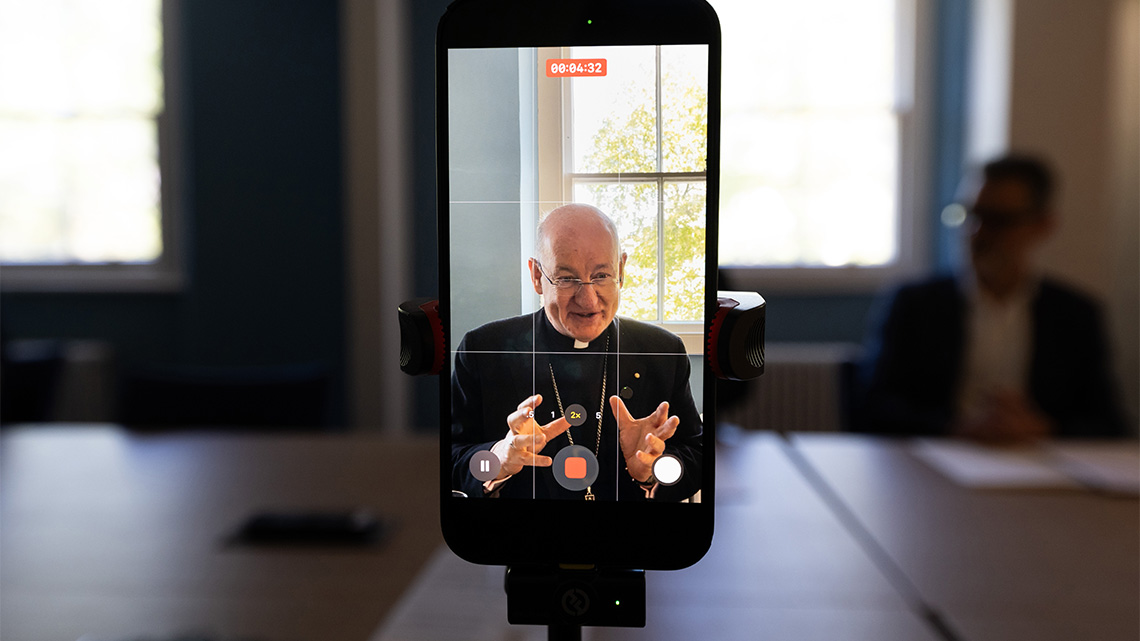
On 29 April, Archbishop Richard Moth, Archbishop of Westminster, led his first press conference as the new President of the Catholic Bishops’ Conference of England and Wales.
The press conference took place to share information and news from the recent plenary meeting of the bishops of England and Wales.
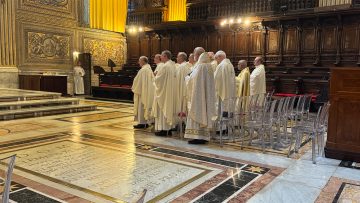
The Bishops held a one-day plenary assembly on Saturday, 18 April, followed by a week of ongoing formation that concluded on Thursday, 23 April. The gathering took place at Convento Palazzola, the Venerable English College’s villa and retreat house just outside Rome. The English College is a seminary that prepares men for the priesthood.
During the plenary meeting, Archbishop Moth was elected President of the Bishops’ Conference by his brother bishops. A second election was also held to replace Archbishop Moth as the Chair of the Department for Social Justice, which will now be held by Archbishop John Sherrington.
Reflecting on his election as President, Archbishop Moth said:
“What really came across at that moment of election was the great support of brother bishops, and a real sense that we work together in a very wonderful and united way. I look forward to being able to serve brother bishops in this new position.”
Archbishop Moth highlighted the role of the Catholic Bishops’ Conference General Secretariat in supporting the ministry of our bishops. Explaining that the foundation of the work and life of the Church is prayer and liturgy, Archbishop Moth said:
“We pray and then we take that relationship with the person of Christ out into the world. That key area of work that really is what the Church is all about, which is bringing the Gospel to the world.”
When asked about his priorities in this role, Archbishop Moth returned to the mission of the Church.
“If we don’t pray we can do nothing, so everything has to grow from that foundation, enabling our faithful to be well-formed in the Gospel and in the life and teachings of the Church. It’s from there that we can be effective in mission. Everything starts with a deepening relationship with the person of Christ that enables us to carry out the mission that he’s given to us.”
Following the plenary, the bishops issued a statement calling for peace. Archbishop Moth explained that the statement was intended to echo and be an expression of support for all that Pope Leo has said in this regard in recent weeks.
“It was really important for us as a Conference of Bishops to underline and add our own voice to the Holy Father’s already strong call for peace and reconciliation across the world.”
Archbishop Moth emphasised that the call for peace reflects a wider concern for the common good among all Christian leaders who share a “desire that all people are able to live in peace and harmony within our society.”
Archbishop Moth recently accompanied the Archbishop of Canterbury, Sarah Mullaly, in her visit to the Holy See and he reflected that the visit was “a very good expression of the work that we seek to do together.”
He acknowledged that both Pope Leo XIV and Archbishop Mullaly recognised that there are “obstacles to be overcome in terms of the work towards unity for which Christ prayed,” but explained that “the wonderful thing to see was the openness of the conversation and the desire to continue to build a relationship that goes back to the 1960s and Archbishop Ramsay’s meeting with Paul VI. It’s very much a continuing tradition.”
Archbishop Moth reflected on recent and future priorities for the Church in England and Wales, drawing particular attention to the Terminally Ill Adults (End of Life) Bill and prisons, for which he retains responsibility in the Bishops’ Conference. Looking ahead to the future, he cited artificial intelligence as “an area of both interest and concern.”