Cardinal Giorgio Marengo has served for 23 years as a missionary priest in Mongolia.
Arriving in the country shortly after his ordination as a priest, he was appointed as the Apostolic Prefect of Ulaanbaatar, a missionary jurisdiction that covers the entire country of Mongolia on 2 April 2020, and was created a Cardinal by Pope Francis on 27 August 2022 – making him the second youngest in the College of Cardinals.
During a recent visit to the UK at the invitation of Missio, the Pope’s charity for world mission, Cardinal Marengo joined us for the Catholic News Podcast.
Cardinal Marengo began his reflections by sharing his deep appreciation for Mongolia and the Mongolian people.
“It’s a wonderful country with a long and very noble tradition of culture, religious spirituality and all sorts of good elements to define a very ancient nation.”
He continued:
“The key element for all of us missionaries is to love the people we have sent to because, first of all, we are guests in their country. If we are there today after so many years, it is because of their goodness and their patience with us. I think love and sincere appreciation, when they’re genuine as they are, they really open many doors because it is clear after maybe an initial suspicion that we are there not for any other purpose than to share the gospel, to share the good news of the Lord and saviour Jesus with all those who are open to that and with great respect for other religious traditions, of course.”
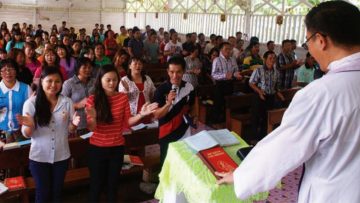
Cardinal Marengo and the community of missionaries in Mongolia, who hail from 25 different nations, could be described as shepherds living among herders.
“The country is huge, six times Great Britain in terms of land, but only 3.2 million inhabitants with 65 million animals. They are great herders. If you want to use an image, we could refer to what the Church was at its very beginning, what we read in the Acts of the Apostles, the first generation Christians, with all that this implies, meaning embracing a new faith, connecting it with one’s cultural identity, sharing the faith with people without the backgrounds. It’s very fascinating, also challenging.”
One of these challenges is communication. English is the common language among the missionaries, despite none of them being native speakers, but the language of their mission is Mongolian, and all missionaries learn, albeit with some difficulty, the local language in order to share the Gospel.
However, there are even greater challenges than learning Mongolian and coping with the bitter winters.
“I would say that most of the challenges come from us, from ourselves, from the fact that we are maybe not enough equipped in order to face this cultural diversity. Many times we don’t have the necessary tools to understand the reality. So, it has to do with personal capacity to get acquainted with a totally different culture.”
Cardinal Marengo went on to explain that these challenges need to be faced with humility and perseverance.
“And then, yes, it’s a constant challenge of discovering new ways, trying maybe one way, if it doesn’t work, the ability and the freedom to change, to learn from our mistakes and to move forward.”
There have been some great high points for the Church in Mongolia in recent times, with the state visit of Pope Francis in 2023 representing a moment of extraordinary welcome, openness and visibility.
“It was a grace for all of us. The fact that the successor of Peter decided to accept the invitation – that was remarkable that the President of Mongolia decided to invite the Holy Father. It was a real state visit. That is the way it was presented to the large audience of course, but it had a very special meaning for us, the small Catholic community. I remember when he was welcomed officially by the civil authorities in the main square of Ulaanbaatar, it was very moving because I thought of our 1,500 Catholic colleagues, having their leader, the spiritual leader, being welcomed with such an honour by the state.”
The memory of the visit is strong today, and members of the authorities still quote his speeches given during the visit.
Cardinal Marengo explained that “Pope Francis was able to really catch the of the culture and to also beautifully express it. In that sense, it was a good way for Mongolia to be more known globally. I remember many journalists asking me, ‘Tell us the true reason why Pope Francis came.’ I said, The only reason is the one he said: ‘I want to pay respect to this noble nation. I want to respect the invitation I received, and I want to see this community.’”
Reflecting on what it means to be a missionary in the modern era, he said:
“We like this expression: ‘Whispering the gospel to the heart of Mongolia’. I find it inspiring because it contains, in a nutshell, all the elements of what mission is. The core is, of course, the person of the Lord, his words, his good news, his message, his gospel. We whisper the gospel, and we share the gospel in this particular way of whispering, which presupposes a relationship with the person. This has to do with the long time we spend in building quality relationships, which is very important everywhere. It has to do also with the fact that the gospel needs to be shared in a very respectful way and also in a spiritual or contemplative way.”
The Cardinal closed with an invitation to renew our commitment to being missionary disciples among our communities.
“This sharing of the Gospel is aimed at reaching out to the heart of a nation, the heart of the person. I’d like to share this image with you all, inviting you also to always rediscover the faith that you have received, that we all have received as the source of our hope, the hope for the world. I think we are all invited to share that hope with the rest of the world.”