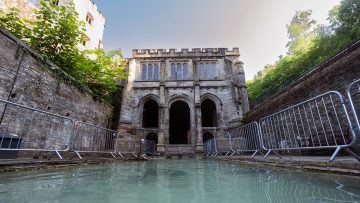
The Catholic National Shrine of Our Lady at the 14th century Slipper Chapel lies a mile south of the village of Walsingham in Norfolk.


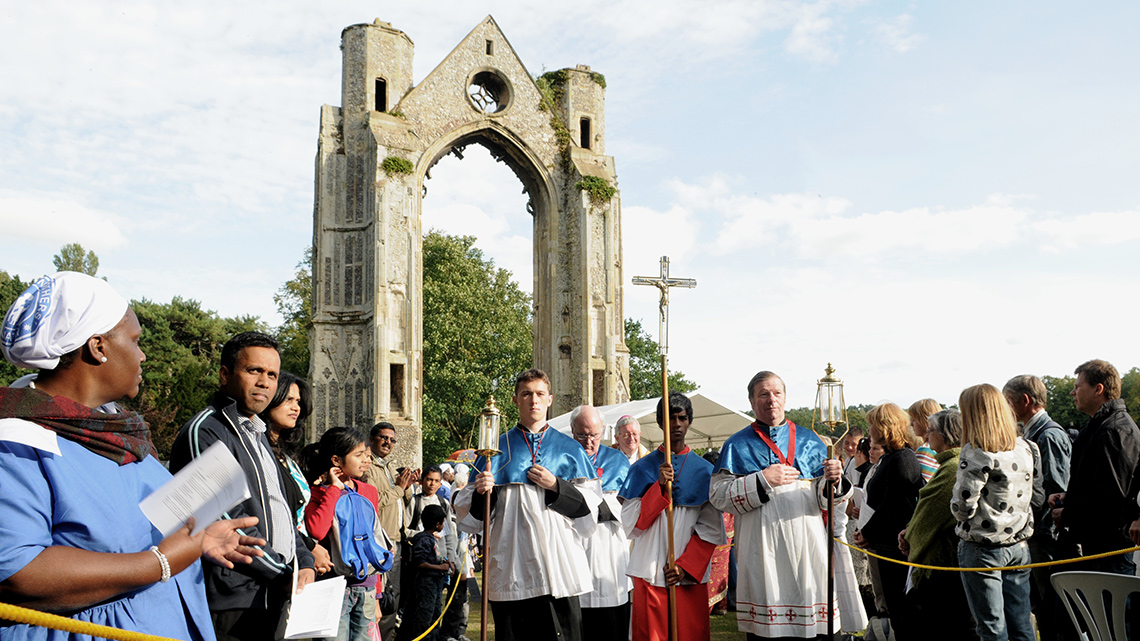
Walsingham is in the county of Norfolk, five miles inland from the North Sea coast. Walsingham is blessed with two Shrines, the Catholic National Shrine of Our Lady at the 14th century Slipper Chapel a mile south of the village and the 20th century Church of England Shrine of Our Lady of Walsingham in the village itself. In Medieval Times the original Shrine was so famous that the area was known as England’s Nazareth.
An ancient Ballad tells us that in 1061, Richeldis, the Lady of the Manor of Walsingham wanted to do something to honour Our Lady, and whilst praying, was taken in a dream to Nazareth, where Mary showed her the Holy House of the Annunciation.
Mary asked Richeldis to build a copy of the Holy House in Walsingham “where shall be had a memorial of my Salutation”.
Richeldis did as Mary asked, and the Shrine became a place of pilgrimage. By 1153, Augustinian Canons had built a Priory beside the Holy House and it became a famous place of Pilgrimage. Rulers of England and other countries visited it for over 300 years, until 1538 when all was destroyed at the Reformation. A Franciscan Friary was erected by Papal permission in 1347.
At the Reformation, the statue from the Shrine was taken to London and burnt along with other statues from other Shrines around the country, Doncaster, Penrhys and Ipswich, being mentioned specifically in a document of 1538. The ruins of Walsingham Priory were sold for £90.
In 1894 Charlotte Pearson Boyd purchased the Slipper Chapel, had it restored in 1897, and gave it to the Catholic Diocese of Northampton.
In 1897, Pope Leo XIII gave his blessing on the re-founding of the Shrine of Our Lady of Walsingham as the Lady Chapel of King’s Lynn Catholic Parish Church. Walsingham was in that parish at the time.
The day following the erection of the King’s Lynn Shrine, 20 August 1897, 40 or so pilgrims came to Walsingham by train, and walked out to pray at the Slipper Chapel. This was the first post-reformation pilgrimage.
In 1921, Rev Alfred Hope Patten was appointed to the Anglican Parish of Walsingham as Vicar. He erected a statue of Our Lady of Walsingham in the Parish Church and in 1931 had the Anglican Shrine Church built in the village, and the statue was transferred to it from the Anglican Parish Church.
In 1934, Cardinal Bourne, on Pilgrimage with 10,000 Catholic Pilgrims, declared the Slipper Chapel to be “The National Shrine of Our Lady for Roman Catholics in England”.
The Slipper Chapel now contains a statue carved by Marcel Barbeau in 1954, which was crowned in Pope Pius XII’s name, by the Apostolic Delegate, Archbishop O’Hara.
When Pope, Saint John Paul II visited Britain in 1982, the Statue was taken to Wembley Stadium where he was celebrating a Mass. After a ‘lap of honour’ around the stadium, the statue was placed on the Altar at the Pope’s request! The Director of the National Shrine and Administrator of the Anglican Shrine both accompanied the statue, and on its return to Walsingham, it paid a short visit to the Anglican Shrine before returning to its home in the Slipper Chapel.
In 2015, the late Pope Francis declared the Catholic Shrine to be a Minor Basilica and in 2019 at the start of the Covid pandemic, about 700,000 people took part online in the Rededication of England as the Dowry of Mary, from Walsingham, a title held by England since the 13th century.
For more information, please visit: walsingham.org.uk