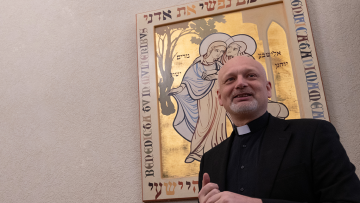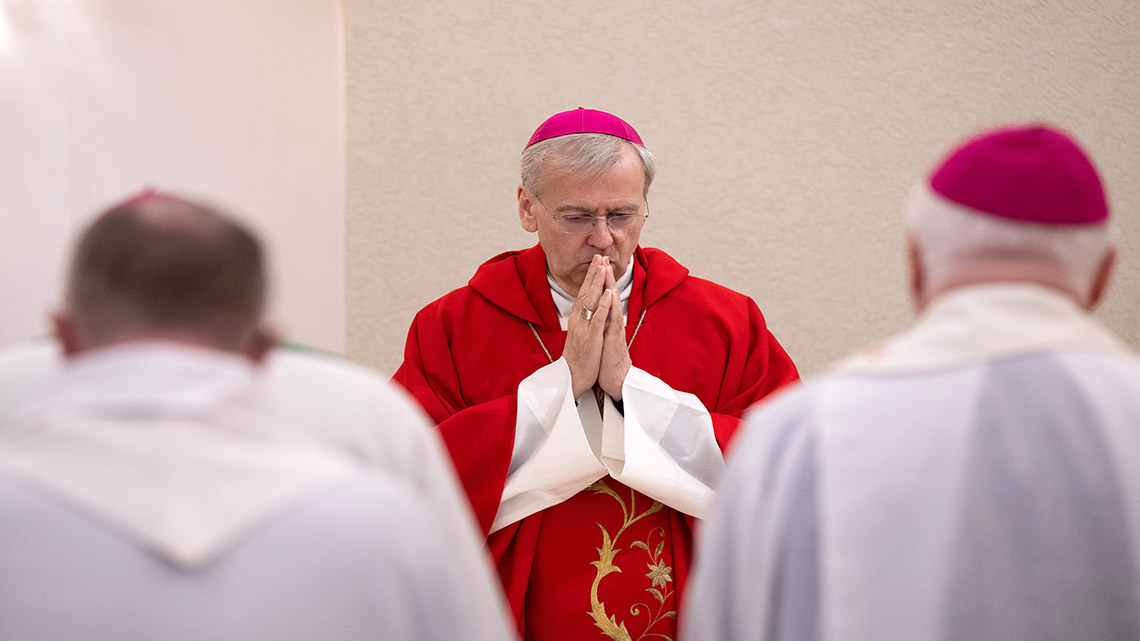
On Monday 19 January, Bishop Nicholas Hudson preached a homily at the Vicariate of St James at a Mass for Hebrew-speaking Catholics in Jerusalem.
Reflecting on the Gospel message, Bishop Hudson said:
“It is our faith – that is to say, we believe – that the wine of God’s love has been poured into our hearts. He has made His home in us. We believe this of the sacraments too, most especially the Eucharist – that His love is literally poured into us as we take the cup and drink of it. But we know too that we need to be changed by it; transfigured by love.”
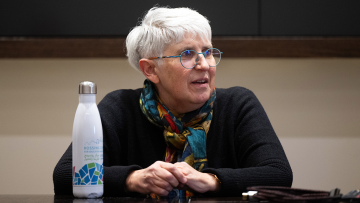
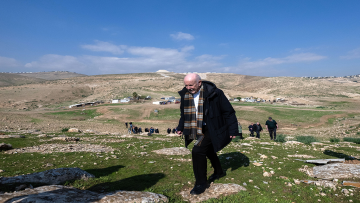
Bishop Hudson shared the powerful experience of meeting with the Comboni Sisters on the first day of the Holy Land Co-ordination pilgrimage.
He said:
“The wine of divine life simply pours out of them and into the Bedouin they serve – to the point that the Bedouin women tell them, “You are the only ones who see us; it is you who give us hope.
“By their choice to live among the Bedouin the Sisters give them hope – a hope which might otherwise elude them. It empowers the Bedouin to say, ‘We want to stay and we know you will help us to’. What the Bedouin experience is the Sisters’ unconditional love.”
“New wine, fresh wineskins” (Mark 2, 22): if we wish to announce Christ, then we probably need to change. That is the message of this Gospel.
It is our faith – that is to say, we believe – that the wine of God’s love has been poured into our hearts. We believe this of our relationship with Him. For He has made His home in us. We believe this of the sacraments too, most especially the Eucharist – that His love is literally poured into us as we take the cup and drink of it. But we know too that we need to be changed by it; transfigured by love.
We met on Saturday two women transfigured by that love. I mean the Comboni Sisters, Lourdes and Marisa. We saw in them the fruit of that love; what happens when people allow themselves to be changed. The wine of divine life simply pours out of them and into the Bedouin they serve – to the point that the Bedouin women tell them, “You are the only ones who see us; it is you who give us hope.”
Hope and trust are very close relatives. The Bedouin clearly trust the Comboni Sisters – to the point that the Bedouin men even allowed us to meet the women alone. That trust is rooted in the choice the Comboni Sisters have made – to live among them. Pope Leo says, in Dilexi te, “A decision to live among the poor should be deemed one of the highest forms of the evangelical life.” (101) The evangelising power of their decision is attested to by the Muslim women who tell them, “The Lord’s Prayer which you teach us contains everything.”
By their choice to live among the Bedouin the Sisters give them hope – a hope which might otherwise elude them. It empowers the Bedouin to say, “We want to stay and we know you will help us to.” What the Bedouin experience is the Sisters’ unconditional love.
Through these Sisters, the Bedouin hear the words of Jesus himself, the words which inspired Pope Leo’s text, words to be found at the very end of the Bible, in the Book of Revelation, where Jesus assures us, “I have loved you”, Dilexi te. (Rev. 3, 9). Through their lives, these Sisters are telling the Bedouin, “Know that He has loved you.” Through these Sisters, the Lord Himself is telling them, “I have loved you”. And it is beautiful to behold.