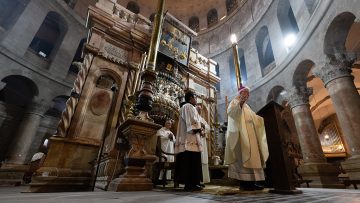
As the 2026 Holy Land Co-ordination pilgrimage concluded in Jerusalem, Archbishop William Nolan, Archbishop of Glasgow, offered his reflections on his ten years of being part of the delegation.
“What inspires me whenever I come are the people that I meet who are so engaged in justice and peace and who continually point out the humanity in the other side and seek justice. Not only are they brave, they’re persistent, and they keep at it year in and year out. So that really inspires me.”
Reflecting on some of the changes that he has seen in his visits to the Holy Land over the last decade, the first thing that Archbishop Nolan noted was the undeniable worsening of the political situation, and the resulting trauma that this inflicts on the local communities:
“We’re now in a situation where after years of conflict and because of the recent wars, everyone is traumatised, so traumatised that they feel their own pain, but they’re not able to even see the pain in the other side. We’ll never make any peace or progress with peace until people start to appreciate that the other side is hurting as well and to recognise the humanity of that other side.”
Another challenge highlighted by Archbishop Nolan is the increasing lack of political good will in Israel for a two-state solution. He explained that at the heart of the conflict lies the fact that the Palestinians are living under a military occupation:
“Unless we try and resolve that conflict and we recognise that there are two peoples, Israeli and Palestinians, who both have the right to live in this land, then peace is still a long, long way off.”
Despite these challenges, Archbishop Nolan retains hope and believes the Church has a crucial role to play in making progress towards a just and lasting peace in the Holy Land:
“I think the Church is a great instrument here for trying to reconcile the communities and to try and establish peace. There is hope because people want peace. Everybody wants peace. No matter what side they’re on, they want peace. Until they start trusting one another and seeing the humanity in one another, then there’ll be no peace.”
One such example is the role religious sisters play, accompanying local communities through these difficult times:
“I’m amazed at the number of religious sisters there are in the Holy Land, and I’m amazed also at the good work they’re doing – not just for the Christian community, but for the broader community, for the Muslim community, for the Bedouin community as well.”
The Holy Land Co-ordination is a pilgrimage in solidarity with the local communities living there – particularly the Christians – the Living Stones. Archbishop Nolan closed his reflection by urging pilgrims to return to the Holy Land, emphasising that it is safe to do so and that it would be a strong sign of support for the local people.
“It is certainly time for the pilgrims to come back. If you want to support the people here in the Holy Land, particularly if you want to support the Christian community, so many of whom are involved in the pilgrim trade, then do come as a pilgrim. But come as a pilgrim also, because this is where we are from. This is where the Church began. This is the land of Jesus. This is our land. So do come and visit it.”