Background and History on the Armenian Apostolic church, delving into it's rich heritage.


The Armenian Apostolic Church, recognized as one of the world’s oldest Christian communities, has played a pivotal role in shaping the spiritual and historical identity of the Armenian people for nearly two millennia. Established in the early 4th century, with roots tracing back to the Apostolic era, this venerable institution transcends religious organization; it embodies national resilience, cultural heritage, and spiritual fortitude. In addition to offering spiritual guidance, the Church has safeguarded Armenian traditions, language, and values, especially during periods of adversity and foreign domination. In contemporary times, particularly amidst challenges such as the conflict in Nagorno-Karabakh and the displacement of the Artsakh population, the Church continues to serve as a source of strength and solace for Armenians. Today, it stands as a beacon of faith, unity, and continuity for Armenians worldwide, providing insights that resonate within the broader global Christian community.
The origins of the Armenian Apostolic Church are deeply rooted in the teachings of the Apostles Thaddeus and Bartholomew, who evangelized in Armenia as early as the 1st century AD. However, it was under the guidance of St Gregory the Illuminator, the first official Catholicos (Patriarch) of Armenia, that Christianity began to flourish. In 301 AD, Armenia became the first nation to adopt Christianity as its state religion under King Tiridates III, an event that distinguished Armenia as a pioneer of the faith long before the Roman Empire’s embrace of Christianity.
The Mother See of Holy Etchmiadzin, located near Yerevan, serves as the spiritual and administrative centre of the Armenian Apostolic Church. Sacred Tradition recounts that St Gregory received a divine vision of Christ descending from heaven and striking the ground with a golden hammer, designating the site for the first Armenian cathedral. This vision led to the construction of the Holy Etchmiadzin Cathedral, one of the oldest churches in the world, symbolizing the enduring bond between the Armenian Church and its faithful. Over the centuries, the Mother See has been a hub of spirituality and ecclesiastical authority, guiding the faithful and preserving Armenian Christian heritage.
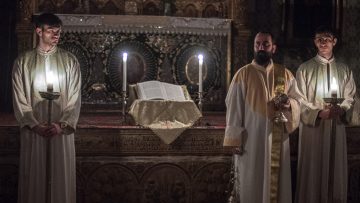
The Armenian Apostolic Church is part of the Oriental Orthodox tradition, characterized by distinctive theological and liturgical practices. Its rituals, shaped by both ancient Christian customs and Armenian cultural influences, reflect profound reverence and spiritual depth. The Divine Liturgy, together with the sacraments of the Church, celebrated in Classical Armenian, incorporate centuries-old chants, incense, and ornate vestments, creating an atmosphere that connects the faithful to the early Church.
The Armenian Apostolic Church, in accordance with the teachings of the first three ecumenical Councils, upholds the Apostolic doctrine of the Holy Trinity and the fullness of Christ’s divinity and humanity, aligning itself with the broader Oriental Orthodox communion. The Church affirms that Christ suffered, was crucified, rose on the third day, and ascended into heaven, and it awaits his glorious return to judge the living and the dead. This Christological understanding profoundly informs the Church’s theological discourse and has shaped its ecumenical relationships throughout history. Through the sacrament of baptism, Armenians are born anew in Christ, participating in the divine life through the sacrament of Holy Communion and the celebration of the Eucharist. The Church confesses the Holy Spirit, who inspired the prophets and apostles, continues to inspire the faithful and guide the Church, which is one, holy, universal, and apostolic. The Church administers one baptism and proclaims the resurrection of the dead, the everlasting judgment, and the promise of eternal life in the Kingdom of Heaven.
Beyond its spiritual mission, the Church has been instrumental in the development of Armenian culture. It played a crucial role in the invention of the Armenian alphabet and the flourishing of Armenian literature and art, including the monumental project of translating the Bible into Armenian. Throughout periods of foreign rule, including the Arab, Mongol, Persian, and Ottoman empires, the Church acted as a guardian of the Armenian language, literature, and arts. Monasteries emerged as centres of learning and cultural production, preserving manuscripts and fostering religious art that embodies Armenian Christian identity. Even under Soviet atheism, the Church maintained a quiet yet resilient presence, supporting the spiritual and cultural needs of the Armenian people.
Throughout Armenia’s turbulent history, the Armenian Apostolic Church has been vital to the survival and resilience of its people. It has provided continuity and stability amid persecution, forced migrations, and genocide. During the Armenian Genocide of 1915, the Church became a sanctuary for those suffering, offering solace and preserving hope for a brighter future. The Church commemorates this tragic event annually, honouring the martyrs’ memory and advocating for recognition and justice.
In modern Armenia, the Church continues to wield significant influence over national life. Following the dissolution of the Soviet Union in 1991, Armenia experienced a religious revival, and the Armenian Apostolic Church reclaimed its central role in society. Today, the Church engages actively in social, educational, and charitable initiatives, addressing poverty, healthcare, and education. It also supports Armenian communities in the diaspora, fostering unity and ensuring that Armenian traditions and faith remain vibrant among Armenians worldwide.
The Armenian Apostolic Church has a rich tradition of ecumenism, striving to build bridges with other Christian communities. In recent decades, it has engaged in dialogue with various denominations, including Roman Catholic, Eastern Orthodox, and Protestant churches, seeking common ground while preserving its unique heritage. The Church’s participation in the World Council of Churches and its relationships with the Vatican and other ecclesial bodies exemplify its commitment to Christian unity and mutual understanding.
The Church’s commitment to dialogue extends beyond Christianity, encompassing interfaith dialogue with other religions, such as Islam. These dialogues have fostered peace and understanding, particularly in a region marked by religious diversity and historical tensions. In this spirit, the Armenian Church has contributed to global discussions on religious tolerance, environmental stewardship, and social justice, reflecting its commitment to values of love, compassion, and respect in a complex world.
A series of reflections and prayers for use over the eight days of the week of prayer for christian unity 2026